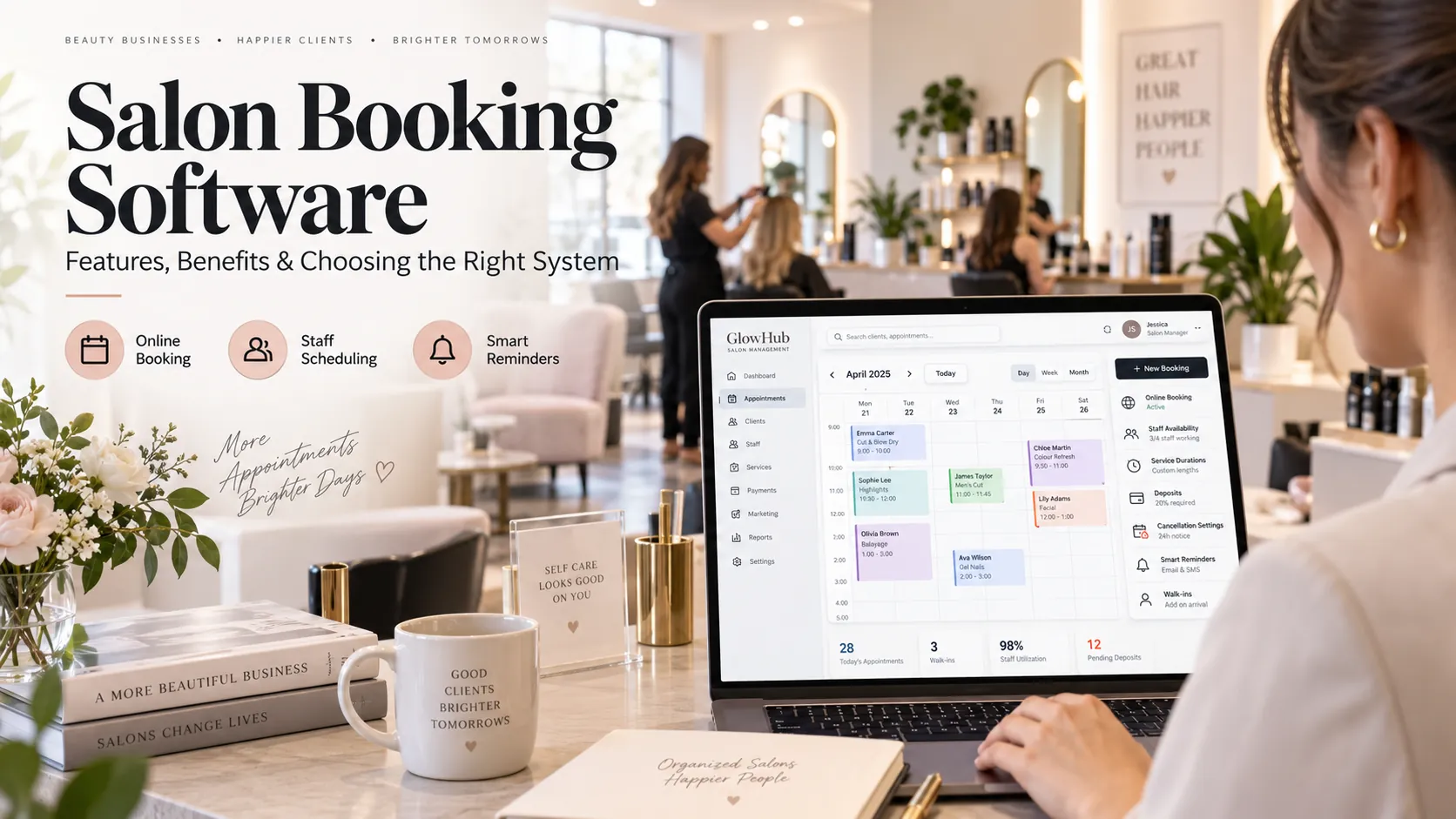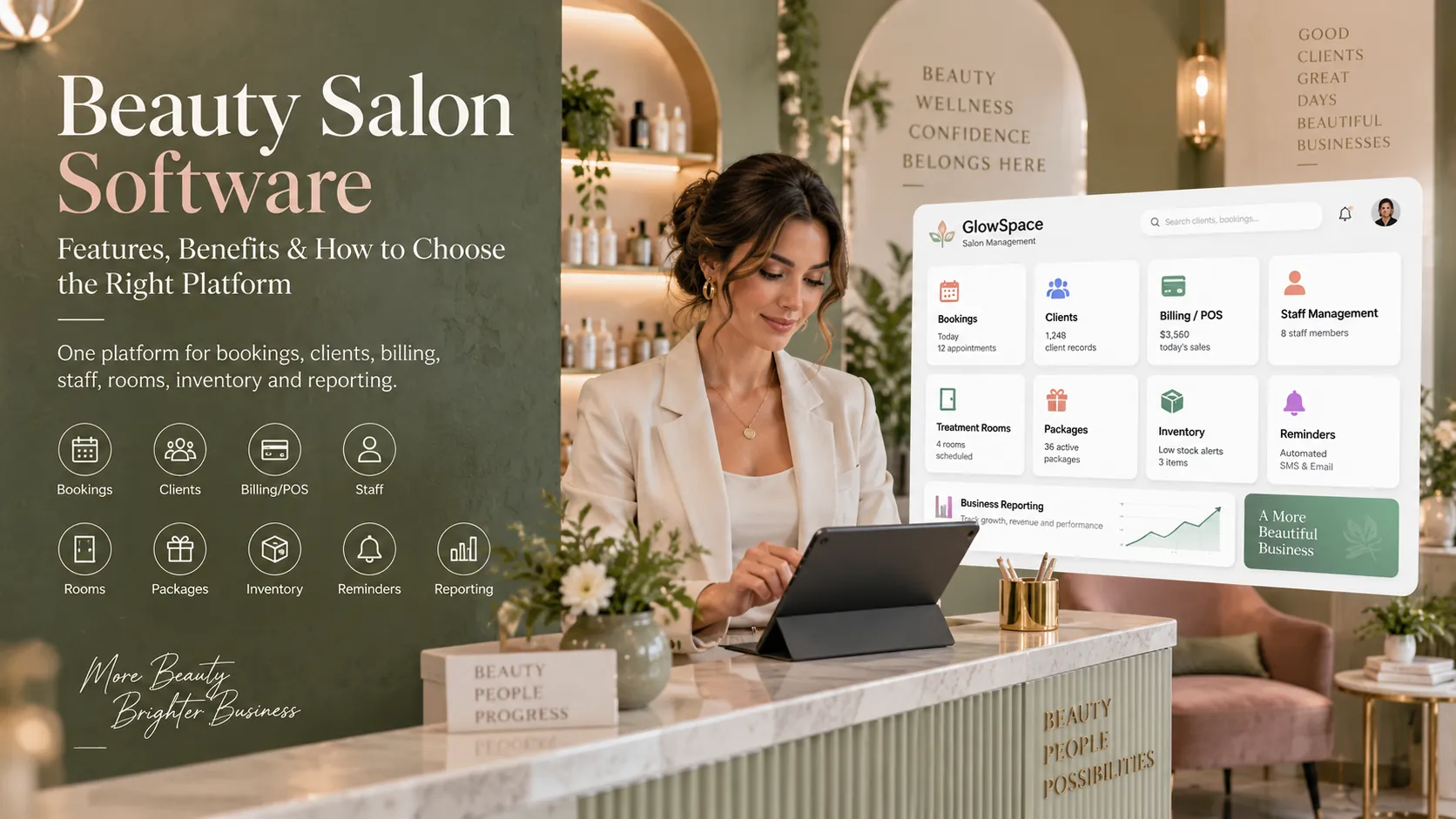
Beauty salon software combines booking, customer records, billing, staff management, treatment-room scheduling, packages, inventory, reminders and business reporting. The best platform can handle multi-service visits and resource-heavy treatments without forcing staff to manage separate calendars or spreadsheets.
Key takeaways
What is beauty salon software?.
Why beauty salons have unique software requirements.
Core features to prioritise.
How to evaluate beauty salon software.
Beauty salons have a scheduling problem that is easy to underestimate.
A customer may book threading and be finished quickly. Another may book a facial that needs a specific room and therapist. A third may combine waxing, manicure and a skin service in one visit. Each service has different staff skills, room requirements, products and timing.
That makes beauty salon software more than an appointment diary. The platform needs to understand how customer journeys, staff capacity, rooms, products, packages and payments fit together.
This guide explains the core features, the beauty-specific workflows to test and a practical way to compare platforms before you migrate your business.
What is beauty salon software?
Beauty salon software is a business-management platform built to run daily beauty operations from one system.
A complete platform may include:
appointment scheduling;
online booking;
client CRM;
treatment history and notes;
POS and invoicing;
staff shifts and attendance;
commission calculations;
room or equipment scheduling;
packages and memberships;
loyalty;
inventory;
WhatsApp/SMS reminders;
marketing automation;
multi-location reporting.
The value is not simply having all of those menus. It comes from keeping the records connected.
A completed facial should update the customer history and bill. If the treatment uses a package credit, the balance should change. If product consumption is tracked, stock should reflect the service. The therapist should receive the correct performance credit. The owner should see the revenue in reporting without manually matching several systems.
Why beauty salons have unique software requirements
Beauty businesses often combine high-frequency services with longer treatment-based services.
That creates three types of capacity:
People capacity. Which beautician, therapist or technician is qualified and working?
Time capacity. How long does the service take, including consultation, preparation and cleanup?
Physical capacity. Is the required room, bed, machine or station available?
Generic appointment tools often model only people and time.
For beauty salons, the physical layer can become the real bottleneck. You may have three therapists free but only one suitable treatment room. If the software does not reserve the room, it can accept appointments the business cannot deliver.
Multi-service bookings are the beauty-salon stress test
One of the best demo scenarios is a customer who books multiple services.
For example:
facial: 60 minutes with therapist A in treatment room 1;
threading: 15 minutes with beautician B;
manicure: 45 minutes with technician C at a nail station.
Ask the vendor to create the visit as one customer journey.
Can the system sequence the services? Can the customer see one sensible start time? Does reception see each staff requirement? What happens if the facial runs 15 minutes late? Can one service be removed without rebuilding the entire booking?
A platform that handles this cleanly is more likely to fit a real beauty operation.
Core features to prioritise
Smart appointment scheduling
The schedule should combine service duration, staff skills, shifts and rooms. Staff leave and breaks should automatically affect availability.
Online booking
Customers should be able to book on mobile without unnecessary form fields. The online calendar must use the same live capacity as reception.
Customer CRM
Profiles can include service history, preferences, notes, packages, memberships, spending and communication history.
The CRM should make repeat service easier, not encourage staff to store unlimited sensitive information without clear purpose or permissions.
POS and GST billing
Checkout should start from the appointment and support services, products, packages, discounts, taxes, split payments and refunds.
For Indian beauty salons, verify GST configuration and the payment methods your customers use, including UPI.
Packages and memberships
Beauty businesses frequently sell prepaid packages or treatment plans.
The software should make it easy to answer:
What did the customer buy?
How many sessions remain?
What is the expiry date?
Which services are eligible?
Which staff member delivered the redemption?
What happens when the package is refunded or adjusted?
If those answers require a spreadsheet, the package module is not doing enough.
Staff and commission management
A commission system should make different earning rules explainable.
For example, a therapist may earn one rate on services, another on retail products and perhaps a bonus after a monthly threshold. Package redemptions and discounts need clear treatment.
The platform should calculate using completed, valid transactions rather than allowing commission reports to depend on manual editing.
Inventory and consumables
Beauty salons use a wide range of consumables: wax, facial products, disposables, nail supplies, skincare and retail items.
You do not need to track every cotton pad with perfect precision. You do need a system that helps identify purchases, consumption, adjustments, low stock and unusual variance.
Choose a level of detail the team can maintain consistently.
Reminders and follow-up
Confirmation and reminder automation should include enough information for the customer to act.
Post-visit follow-up can be service-specific. A customer who completed a facial may need a different next-contact schedule from someone who booked threading.
This is where connected customer history improves marketing quality.
Beauty salon CRM: what data is actually useful?
A large database is not automatically a useful CRM.
Focus on information that helps service, retention or legitimate operational needs.
Useful fields may include:
last service;
preferred professional;
typical visit frequency;
active package;
loyalty balance;
preferred communication channel;
future appointment status;
product purchases;
customer value over time.
The CRM should also prevent duplicates. If the same customer is created several times because of different phone-number formats or booking channels, marketing and reporting become unreliable.
WhatsApp-first workflows in India
For many Indian beauty salons, WhatsApp is already part of the customer journey.
Customers enquire about prices, ask for slots, share references, reschedule and respond to offers.
The objective is not to eliminate WhatsApp. It is to stop WhatsApp from becoming a second unstructured database.
A strong workflow is:
customer conversation starts on WhatsApp;
the confirmed appointment is created in the salon system;
the platform becomes the source of truth for date, time, staff and service;
WhatsApp is used for confirmation, reminder and follow-up;
the completed visit updates CRM and billing.
That preserves the communication channel customers like while keeping operations structured.
AI opportunities for beauty salons
AI can be useful in areas where managers spend time interpreting data.
Examples include:
summarising daily or weekly performance;
identifying customers whose visit pattern has changed;
suggesting segments for treatment follow-up;
flagging unusual cancellation or no-show patterns;
helping owners ask questions about staff or service performance;
highlighting stock items with unusual consumption.
AI should not be treated as a substitute for accurate data.
If therapists do not mark services complete, packages are redeemed outside the system or product adjustments are skipped, AI will produce confident answers from incomplete records.
Build the data habit first.
Multi-location beauty salons
A growing beauty brand needs more than a shared login for each branch.
Look for:
branch-level staff and permissions;
different price lists where required;
central and branch-specific services;
customer visibility rules;
branch-level package redemption rules;
stock transfers;
consolidated revenue reporting;
branch comparison;
central campaign management;
audit logs.
A good multi-location system lets the owner see the whole network while still allowing each branch to operate quickly.
How to evaluate beauty salon software
Use a practical scorecard rather than a generic demo.
Service complexity
Can the system handle short services and long treatments in the same calendar?
Room scheduling
Can it reserve treatment rooms and equipment automatically?
Combination bookings
Can one customer book several services with different staff?
Packages
Can staff understand balances and redemption at a glance?
Mobile usability
Can reception and managers complete common tasks on a phone?
CRM quality
Can staff see useful history without searching several screens?
Billing
Does checkout reflect the appointment and package usage correctly?
Permissions
Can you restrict refunds, exports, price changes and financial reports?
Inventory
Can you track both retail and service-use stock at a practical level?
Data portability
Can you export customers, appointments, sales and products?
Support
Can the vendor answer workflow questions, not only login issues?
A sensible implementation plan
Start by cleaning the service catalogue.
Beauty businesses often accumulate duplicate service names over time: “Full Arms Wax,” “Arms Full,” “Full Hand Wax,” and so on. Standardise the names, categories, duration and prices before migration.
Then configure:
staff skills;
staff shifts;
treatment rooms;
equipment;
service buffers;
tax rules;
packages;
memberships;
commission rules;
cancellation policy;
reminder templates.
Import customer data after removing duplicates.
Before going live, ask staff to test real scenarios: a walk-in, a multi-service appointment, a package redemption, a late arrival, a therapist absence and a refund.
Do not launch automation until the team can complete the basic visit correctly.
Metrics beauty salon owners should review
A useful dashboard may include:
bookings today and tomorrow;
cancellations and no-shows;
room utilisation;
therapist utilisation;
repeat-visit rate;
package sales and redemption;
average bill value;
revenue by service;
retail product sales;
new vs returning clients;
stock alerts;
customer rebooking.
Review exceptions daily. Review trends weekly or monthly.
This reduces the temptation to react to one unusual day.
Common mistakes to avoid
Buying for the feature list. A long list can hide shallow workflow support.
Ignoring room capacity. Staff availability does not mean treatment capacity is available.
Migrating messy data. Duplicate clients and inconsistent services create poor reports immediately.
Using shared logins. You lose accountability and permissions become meaningless.
Over-automating marketing. Generic campaigns can annoy customers when CRM data is weak.
Tracking inventory at an unrealistic level. A system nobody updates is worse than a simpler one the team maintains.
Search and AI usefulness
This article keeps beauty salon software as the primary subject and answers the main follow-up questions within one page rather than creating thin pages for minor keyword variations. For stronger visibility over time, add original screenshots, workflow diagrams, verified customer examples and first-party benchmarks when available. Those assets give readers information that generic summaries cannot reproduce.
Frequently asked questions
What does beauty salon software do?
It centralises appointments, customer history, billing, staff, packages, inventory, reminders and reporting so the business can operate from one connected system.
Is beauty salon software different from general salon software?
The core functions overlap, but beauty-focused operations may require deeper support for treatment rooms, multi-service visits, packages and consumable-heavy services.
Can it manage several treatments in one visit?
It should. Test whether the system can sequence services across different staff and resources while preserving one customer journey.
Can beauty salon software manage packages?
Many platforms can. Check session balances, expiry, partial redemption, refunds and how package usage flows into billing and commission.
Is WhatsApp integration important?
It can be very useful in India if customers already use WhatsApp for confirmations and follow-up. The operational record should still live in the salon system.
What is the best way to compare platforms?
Give every vendor the same real scenarios and score how each product handles them. Do not compare only presentation slides or feature names.
Final thoughts
The right beauty salon software should reduce the invisible coordination work that keeps a beauty business running.
It should know not only that a customer has an appointment, but which staff member, room, package, products and payment rules are connected to that visit.
When those relationships are captured well, the salon gains more than convenience. It gains a cleaner operating system for customer experience, team performance and growth.