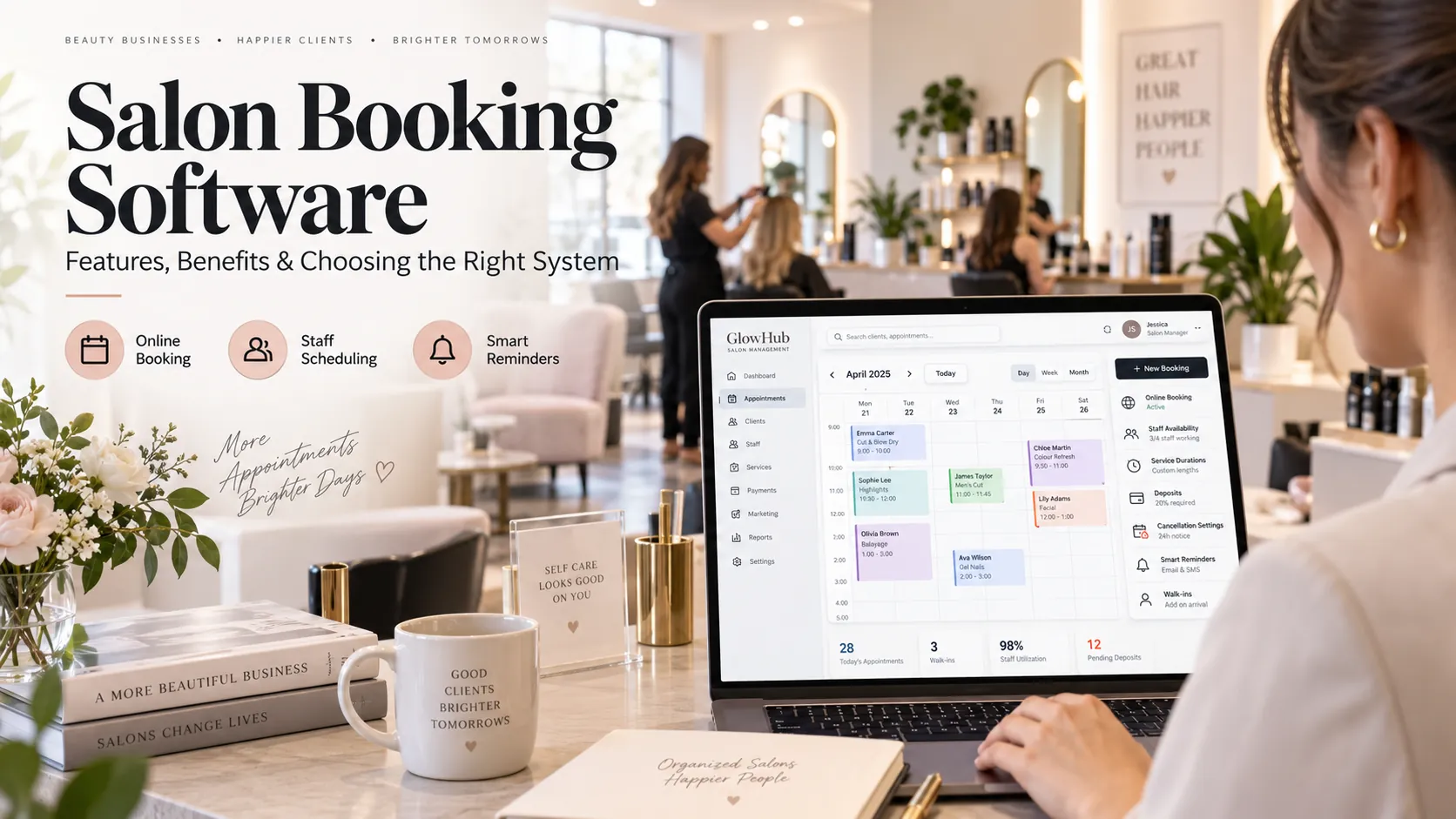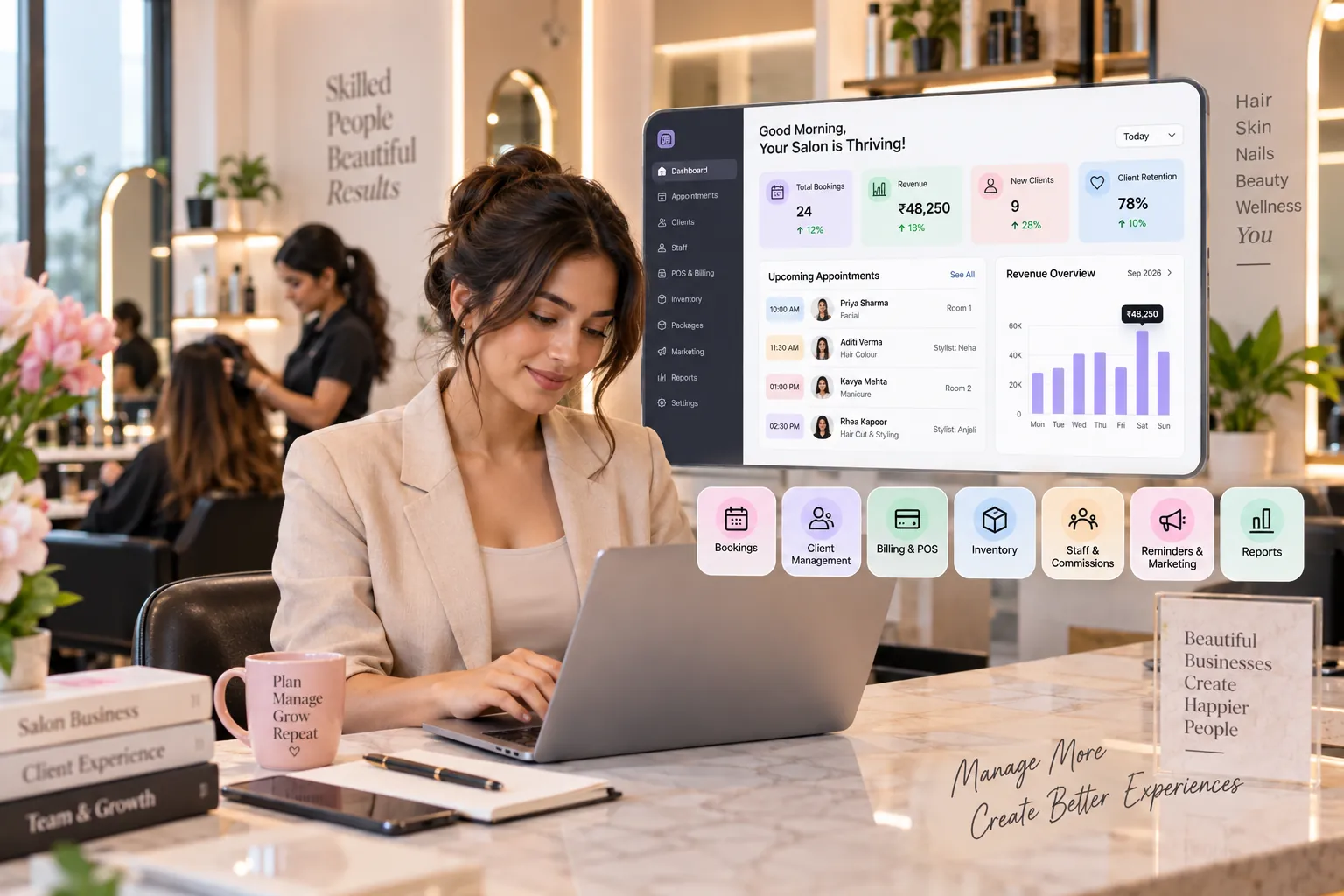
Quick answer: Beauty salon management software is an integrated platform for bookings, client records, treatment rooms, billing, packages, staff, commissions, inventory, reminders and performance reporting. It helps owners run a service business where staff skill and physical resources must be coordinated together.
Key takeaways
- Build the system around the customer visit.
- Treatment rooms are management assets.
- Staff skills.
- Packages.
- Memberships.
Beauty salon management is rarely difficult because of one big problem.
It is difficult because dozens of small details need to stay aligned.
The therapist is working, but the treatment room is full. The customer has a package, but reception cannot see the balance. A staff member sold a product, but the stock sheet has not changed. A client rescheduled on WhatsApp, but the calendar still shows the old time.
Beauty salon management software is valuable when it removes those gaps.
Build the system around the customer visit
A useful management platform follows the visit from beginning to end.
Booking
Customer, service, staff, room and time are reserved.
Preparation
Relevant history and instructions are visible.
Arrival
Reception checks the customer in.
Service
Staff deliver the treatment and update changes.
Checkout
Services, products, packages and payments are reconciled.
Follow-up
The customer is rebooked or enters an appropriate retention journey.
Each stage should update the same customer and business record.
Treatment rooms are management assets
Rooms generate revenue only when they are used by the right service.
Track room utilisation separately from staff utilisation.
If therapists are 60% utilised and rooms are 95% utilised, adding staff may not increase capacity.
If rooms are empty but customers cannot get appointments, the bottleneck may be skill, shifts or demand.
This is why resource scheduling belongs in management reporting.
Staff skills
Beauty staff may specialise in:
- skin;
- waxing;
- nails;
- makeup;
- advanced treatments;
- hair;
- bridal.
Assign skills in the system.
This improves online booking, roster planning and training decisions.
A manager can see where the business depends on one specialist and decide whether to cross-train another employee.
Packages
Beauty salons often rely heavily on packages.
Management software should make package economics visible.
The owner needs to know:
- packages sold;
- value collected;
- sessions remaining;
- redemption;
- expiry;
- refund;
- unredeemed liability.
Reception needs a simpler view:
- Is this customer eligible?
- How many sessions remain?
- What can be booked?
The same data serves different roles.
Memberships
Memberships can create recurring revenue and retention.
The software may need to manage:
- billing cycle;
- included services;
- member pricing;
- renewal;
- pause;
- cancellation;
- branch eligibility.
Avoid creating membership rules that staff cannot explain at checkout.
Simple benefits are easier to deliver consistently.
Staff commission
Beauty commission can become complex when packages and discounts are involved.
Decide in advance:
- Is commission based on list price or collected value?
- What happens on package redemption?
- What happens after refund?
- Is retail commission separate?
- Are targets monthly?
Configure the rule and document it.
The software should calculate the same way every time.
Inventory and consumables
Beauty salons use both retail and treatment stock.
Examples include:
- wax;
- facial kits;
- skincare;
- disposables;
- nail products;
- cosmetics.
Use different tracking methods based on value and risk.
A high-cost facial kit may justify service-level consumption. Low-cost disposables may be better managed through periodic counts.
Do not let the inventory module dictate an impractical workflow.
CRM
Beauty CRM should help answer:
- What did the client last book?
- What package do they have?
- Who served them?
- When do they usually return?
- Do they have a future booking?
- What products did they buy?
- Which channel do they prefer?
Retention depends on context.
A large customer list without visit history is limited.
WhatsApp communication
For many Indian beauty salons, WhatsApp is a primary communication layer.
Connect it to structured customer events.
Examples:
- booking confirmation;
- reminder;
- package expiry;
- service-due reminder;
- membership renewal;
- feedback request.
Avoid exporting lists and sending the same campaign to everyone.
The system should help segment based on history.
Billing and GST
At checkout, the software should support:
- service;
- product;
- package;
- membership;
- discount;
- GST;
- split payment;
- UPI;
- card;
- cash;
- refund.
The final invoice should match the operational visit.
If staff changed the service during the appointment, checkout should receive the updated service.
Management dashboard
Daily:
- appointments;
- cancellations;
- no-shows;
- sales;
- staff attendance;
- room occupancy;
- payment mismatch.
Weekly:
- therapist utilisation;
- package redemption;
- rebooking;
- repeat customers;
- service mix;
- retail.
Monthly:
- retention;
- membership;
- branch performance;
- inventory variance;
- staff productivity;
- average bill value.
The owner should not need one dashboard for every module.
AI use cases
AI can help beauty salon managers explore operational data.
Examples:
- Which clients are due for a facial?
- Which package is under-redeemed?
- Which staff have unused capacity?
- Which treatment room has the lowest utilisation?
- Which services are becoming more popular?
- Which stock items have unusual consumption?
Use AI to prioritise analysis.
Keep the source records accessible.
Implementation
Clean services
Remove duplicate names and confirm duration.
Map staff skills
This affects booking and scheduling.
Define rooms and equipment
Add only real constraints.
Configure packages and memberships
Verify opening balances.
Set commission
Document rules.
Clean customers
Deduplicate.
Clean products
Standardise units and opening stock.
Test
Run a normal day plus a package redemption, room conflict, staff absence, refund and multi-service visit.
Train
Train by role.
Buying checklist
Test:
- room-aware online booking;
- multi-service;
- package redemption;
- membership;
- staff leave;
- commission;
- GST bill;
- split payment;
- inventory adjustment;
- customer follow-up;
- branch reports;
- export.
The live test is more useful than the feature brochure.
Price-list governance
Beauty service menus change frequently.
New treatments are added, packages are promoted and introductory prices expire.
The system should make price changes controlled and traceable.
Consider:
- effective date;
- branch;
- member price;
- package price;
- tax;
- staff permission.
Avoid editing historical transactions when changing current price.
A good system preserves what the customer actually paid at the time.
Bridal and occasion management
Beauty salons may sell bridal or event packages that span several dates.
A single customer could have:
- trial;
- pre-bridal treatments;
- makeup;
- hair;
- family services;
- staged payments.
Management software should help keep those appointments and payments connected to the same customer and package.
Do not treat a multi-date bridal sale as one generic appointment if staff and capacity need to be managed separately.
Multi-location beauty management
Chains should test central vs branch control.
The head office may manage:
- service standards;
- reporting;
- campaigns;
- customer data;
- packages.
Branches may manage:
- daily schedule;
- local staff;
- stock;
- walk-ins;
- closing.
Permissions should support this split.
If every branch can edit global services and prices, central consistency becomes difficult.
Data-quality routine
Create a weekly review for:
- duplicate customers;
- open appointments;
- negative stock;
- expired package exceptions;
- unusual discounts;
- unmatched payments.
This small routine protects reporting quality.
The system becomes more valuable as the team trusts the data.
AI-assisted retention
AI can help prioritise customer follow-up by looking at visit history and future bookings.
For example, it can help identify customers who usually return every month but have not booked again.
The output should become a reviewable segment, not an automatic assumption.
Managers should still apply business judgment and customer consent before messaging.
Customer acquisition and repeat behaviour
Beauty salons often advertise introductory offers.
Management software should help the owner see what happens after the first visit.
Track the cohort:
- first visit source;
- first service;
- first-visit discount;
- second visit;
- time to return;
- package purchase;
- long-term spend.
A campaign that generates many cheap first visits may be less valuable than one that brings fewer clients who return.
This connection between marketing and CRM is where salon data becomes commercially useful.
End-of-day control
At closing, the manager should be able to reconcile payments, review refunds, check open bills and confirm that completed appointments have been closed.
This is also a good time to review unusual discounts and package adjustments.
A clean close creates cleaner reporting tomorrow.
Measuring utilisation without overloading the team
High utilisation is useful only when the schedule remains realistic.
Review therapist and room utilisation alongside delays, cancellations, customer waiting and staff breaks.
If utilisation rises while service quality falls, the business has exceeded comfortable capacity.
Use the data to adjust service duration, rosters or room allocation rather than simply telling staff to work faster.
Support quality
During a trial, ask the vendor an operational question rather than a password-reset question. Good support should understand packages, rooms, commissions and billing well enough to help configure the workflow, not merely point to a help article.
Search and AI usefulness
This article keeps beauty salon management software as the primary subject and answers the main follow-up questions within one page rather than creating thin pages for minor keyword variations. For stronger visibility over time, add original screenshots, workflow diagrams, verified customer examples and first-party benchmarks when available. Those assets give readers information that generic summaries cannot reproduce.
Frequently asked questions
What is beauty salon management software?
It is software that manages beauty bookings, customer history, staff, rooms, billing, packages, inventory and reporting in one platform.
Can it manage treatment rooms?
A suitable beauty platform should. Test whether rooms affect online availability.
Can it track packages?
Most full systems can. Verify session balance, expiry, redemption and refunds.
Can it calculate staff commission?
Many platforms can. Package and discount rules need careful configuration.
Does it support WhatsApp?
Some systems integrate with WhatsApp Business messaging. Check templates, automation, costs and consent.
What should I implement first?
Start with services, staff, rooms, booking and billing. Add advanced marketing after the core workflow is stable.
Final thoughts
The best beauty salon management software makes resources, customer relationships and commercial data visible in one place.
That allows the owner to answer better questions about capacity, staff, packages and retention.
It also gives the team fewer reasons to keep unofficial spreadsheets or message-based records outside the system.
Related reading
- [Salon Management Software: Core Features, Benefits & Implementation Guide](/blog/salon-management-software/)
- [Hair Salon Management Software: Core Features, Benefits & Implementation Guide](/blog/hair-salon-management-software/)
- [Beauty Salon Software: Features, Benefits & How to Choose the Right Platform](/blog/beauty-salon-software/)
- [Salon Software: Features, Benefits & How to Choose the Right Platform](/blog/salon-software/)