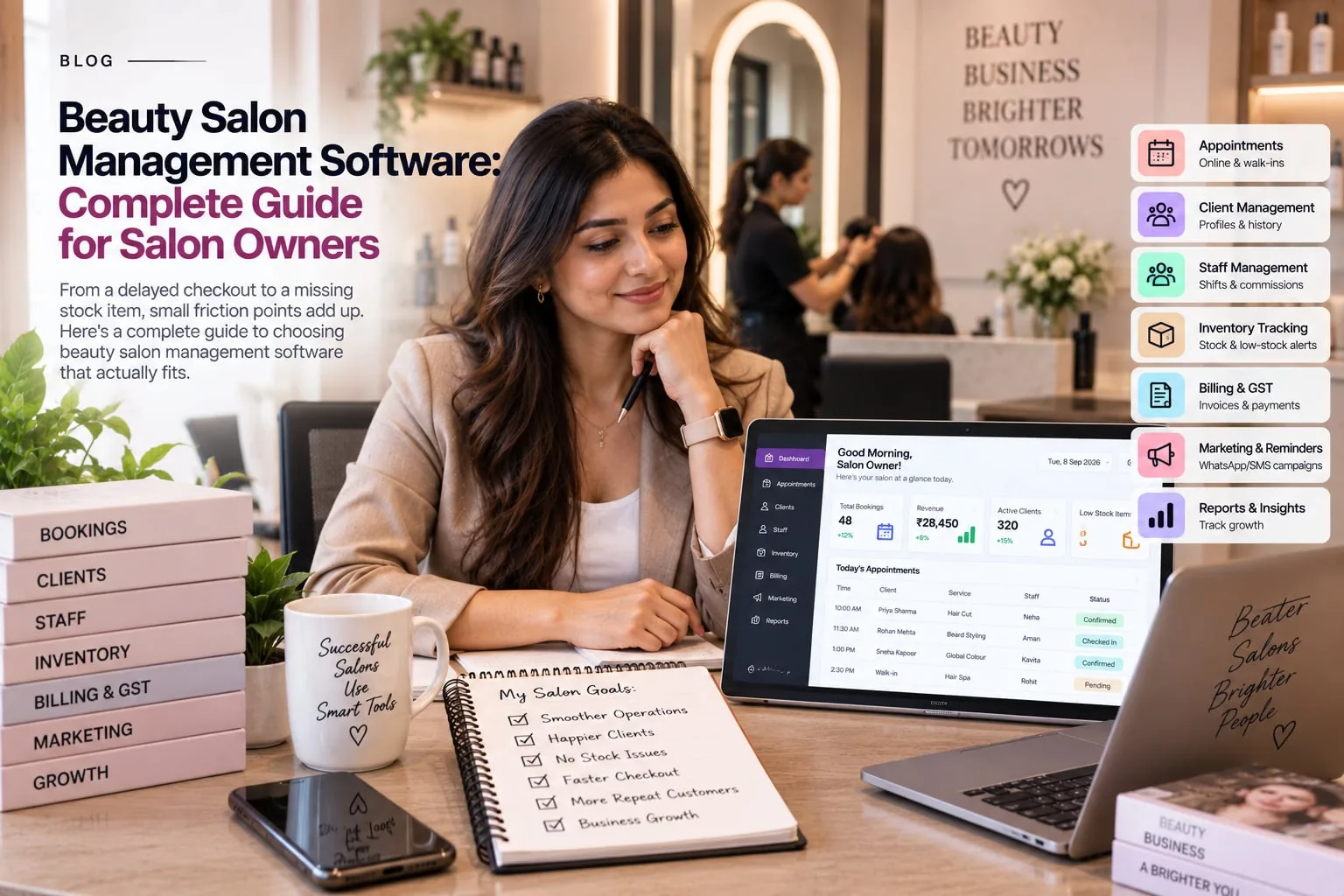
The useful question is not whether a salon should become digital. It is which parts of the day deserve to become easier, faster and more reliable. This guide is for salon owners and managers who are researching salon management software. Its search intent is mainly problem-solving informational: the reader wants to understand the category, judge what matters and avoid a purchase that creates a new layer of admin instead of removing one.
Now put a busy front desk where walk-ins, booked clients and payment questions arrive together into a busy shift. The operating tool has to keep the relevant context together, because staff cannot pause customer service to reconcile several disconnected sources.
Why this category matters now
Salon Management Software is best understood as a business workflow category rather than a single feature. For salon owners and managers, the goal is to reduce double entry, missed follow-ups, unclear staff availability while keeping the customer experience personal. A capable system should make information easier to capture once, reuse safely and report later. It should not force the team to become software operators at the expense of serving clients.
What belongs inside salon management software depends on scale. Small businesses can keep the setup focused; larger operations benefit when related functions share data instead of becoming separate systems.
Core jobs the software must perform
Consider this situation: A regular customer walks in without an appointment but wants the same professional and service combination as last time. A disconnected setup makes the team translate the same information between people and tools. A connected salon management software workflow should preserve the booking or transaction context, show the next action clearly and leave a trace that can be reviewed later.
This is why double entry and missed follow-ups are not merely administrative irritations. They consume attention at exactly the moment staff should be focused on the client. Reducing those small interruptions can improve consistency without making the salon feel automated or impersonal.
What the front desk experiences
At first, Double Entry can be hidden by staff memory and informal coordination. With higher volume, that safety net disappears and the business begins spending time verifying which record is correct.
The deeper risk of missed follow-ups is confidence. A process nobody fully trusts encourages side spreadsheets and chat messages, which fragments information further.
Once unclear staff availability is accepted as 'just how things work', leaders spend more time reconstructing events than preventing them. Early visibility is therefore a practical requirement, not a reporting luxury.
A salon can tolerate occasional fragmented reporting, but it should not need a daily manual control to compensate for it. That is a sign the workflow and the operating process are misaligned.
What the owner should see
Appointments
The value of appointments becomes obvious only in everyday use. The calendar should understand more than a start time. Service duration, staff skills, buffers, leave and resource availability all influence whether a slot is genuinely bookable. If staff need a spreadsheet or WhatsApp note to complete the same process, the feature is not fully connected.
Billing
A strong implementation of billing should reduce decisions the team has to reconstruct manually. Billing should connect services, products, discounts, taxes and payment modes so the amount collected can be reconciled with the day's sales without reconstructing the story later. The best test is whether a new receptionist can understand what happened without asking the person who entered it.
Client Records
One area to examine closely is client records. A useful client profile keeps visit history, preferences, notes and commercial information together, while still giving the business sensible controls over who can see or edit it. The best test is whether a new receptionist can understand what happened without asking the person who entered it.
Memberships
Do not treat memberships as a checkbox. Membership and package logic needs clear balances, expiry rules and redemption history. Ambiguity at the front desk quickly becomes a customer-service problem. This is also where reporting quality begins: clean operational inputs create reports that managers can trust.
Inventory
For salon management software, inventory deserves a live test. Inventory should reflect both retail movement and professional consumption. A salon may sell a shampoo bottle but consume colour, developer or wax in smaller units behind the scenes. This is also where reporting quality begins: clean operational inputs create reports that managers can trust.
Staff Controls
The value of staff controls becomes obvious only in everyday use. Staff controls should cover availability, permissions and performance without turning the system into a surveillance exercise. The point is operational clarity, not micromanagement. A salon should be able to configure the rule once, train the team and then use it consistently across busy and quiet periods.
Reports
A strong implementation of reports should reduce decisions the team has to reconstruct manually. Reports are only useful when they lead to an action. Revenue by service, occupancy, repeat behaviour and stock variance are more valuable than dashboards nobody discusses. A salon should be able to configure the rule once, train the team and then use it consistently across busy and quiet periods.
Where automation helps - and where people still matter
Local fit is less about adding the word 'India' to a feature page and more about handling the way Indian salons actually operate. Test tax configuration, payment modes, mobile numbers, messaging workflows, branch structures and service packages with real examples from your business.
A platform is locally suitable only if it survives everyday use. Watch where people step outside salon management software; those detours often reveal missing rules, poor setup or an unnecessarily complicated screen flow.
How to compare vendors fairly
The return from salon management software should be measured in operational outcomes, not login counts. A useful scorecard for this topic includes repeat visits, occupancy, average bill value and reconciliation accuracy. Choose three or four measures before implementation and record a baseline so the owner can see whether the new process is genuinely improving the business.
Do not judge salon management software only by whether monthly sales rise. If the team spends less time correcting records, the owner reconciles faster and customers get more consistent answers, the system is already creating measurable operating value.
Numbers to track after launch
- Can you demonstrate appointments using our own service menu rather than sample data?
- What happens when double entry occurs - can staff correct it without losing history?
- What would make the annual bill higher than the quoted plan price - extra seats, branches, messaging volume, setup work or connected apps?
- What is our exit path: can we download usable customer, sales, package and inventory data without relying on a custom support request?
- Which permissions can be limited by role, branch or responsibility?
- When a new receptionist joins three months later, what training material or live support can the business use?
A good sales demo should survive these questions comfortably. The aim is not to catch the vendor out; it is to discover whether the system can handle the ordinary exceptions that make salon operations real. For salon management software, one live end-to-end workflow is more informative than twenty screenshots.
A short implementation playbook
- A smaller clean database is more valuable than a huge unreliable one. Prepare verified customer records and active entitlements before the salon management software import.
- Keep the first salon management software training session practical. Use real services and let staff repeat the everyday flows until they can complete them without relying on a trainer.
- Treat the opening week as a monitored launch. Review salon management software transactions each evening and correct configuration errors while the underlying customer visit is still fresh.
- A successful salon management software rollout eventually simplifies the toolset. When users trust the new process, remove redundant diaries and spreadsheets so staff are not deciding which record is current.
- Before staff training starts, tidy the service master used by salon management software. Consistent naming, realistic timings and accurate prices prevent avoidable calendar and billing errors later.
- Permission design is easier before launch than after it. Decide who can edit prices, issue refunds, export records or change settings, then create salon management software accounts around those decisions.
Implementation succeeds when the team understands why the process changed. Explain the customer or business problem behind each rule. People are more likely to use salon management software correctly when they can see that it prevents a specific headache rather than simply satisfying management's desire for a new system.
Bottom line
If you are considering Wellnito, bring a real service menu, sample package rules and the reports you currently use. Ask the product team to recreate a normal day and one difficult edge case. That approach gives a clearer answer on suitability than a generic presentation and also helps identify what needs configuration before launch.
Frequently Asked Questions
How quickly can a salon team learn the system?
A well-configured salon management software system should not require weeks of classroom training for basic tasks. Short role-specific sessions, practice and a simple reference guide are usually more effective than one exhaustive demonstration.
Does salon software remove the need for staff judgement?
No. The role of salon management software is to reduce repetitive admin and make context visible, not to automate empathy or managerial judgement. Staff should still have controlled ways to handle genuine exceptions.
What data should be prepared before implementation?
Build a clean implementation file for salon management software containing active services, pricing, timings, staff roles, stock units and prepaid entitlements. Leave uncertain legacy data out until it can be verified.
How should I compare the price of two salon platforms?
Use total cost of ownership for salon management software, not the advertised starting price. Include every required module and usage charge, then assess whether the workflow improvement justifies the spend.
What reports should an owner review every month?
For this topic, start with repeat visits, occupancy, average bill value and reconciliation accuracy. A monthly review should be short enough that managers use it consistently and specific enough to trigger a decision.
Conclusion
Salon Management Software: Features, Benefits & Complete Guide is ultimately a business-process question. The strongest salon management software is the one that matches how your salon actually works, removes repeated manual steps and gives staff enough context to serve customers confidently. Use the keyword research to find the category, but use real workflows to make the buying decision. Measure the result through repeat visits, occupancy, average bill value and reconciliation accuracy, and keep the setup simple enough that the team can follow it on the busiest day of the week.