Quick answer: Hair salon management software connects the operational and commercial parts of a hair business: appointments, client history, stylist schedules, POS, commissions, colour and retail inventory, packages, reminders and reporting. The right system should help owners understand capacity and profitability without making stylists or reception maintain duplicate records.
Key takeaways
- What does hair salon management software manage?.
- Manage hair-salon capacity, not only appointments.
- Stylist books and customer relationships.
- Commission management.
- Hair colour and back-bar inventory.
Hair salons are relationship businesses, but they are also capacity businesses.
Revenue depends on how well the salon uses stylist time, chairs, wash stations, assistants and high-demand appointment windows. Profit depends on service mix, pricing, staff compensation, product use and retail.
That makes hair salon management software more than an appointment diary.
It should help the owner connect the customer journey with the economics behind it.
What does hair salon management software manage?
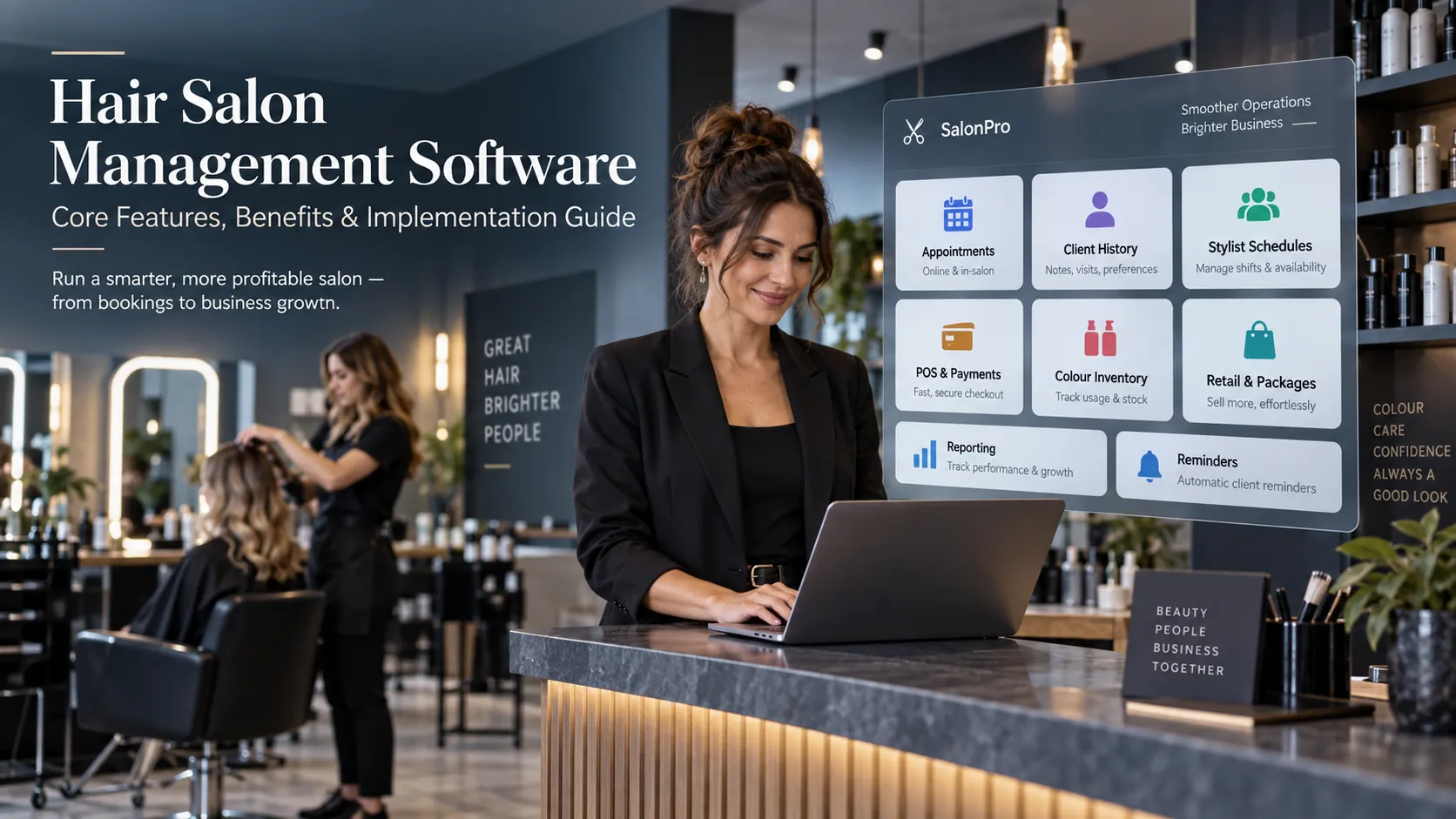
A full platform may include:
- bookings;
- online booking;
- stylist shifts;
- assistants;
- customer profiles;
- formulas or service notes where appropriate;
- POS;
- taxes;
- payments;
- deposits;
- commission;
- back-bar inventory;
- retail inventory;
- packages;
- loyalty;
- WhatsApp/SMS;
- campaigns;
- multi-location reporting.
The key is integration.
When a colour service is completed, the same event can update the bill, client history, stylist performance, product consumption and retention timeline.
The owner should not need four different systems to reconstruct that visit.
Manage hair-salon capacity, not only appointments
Capacity is shaped by:
- staff skills;
- staff hours;
- chairs;
- wash stations;
- colour processing;
- assistants;
- buffers.
A salon can have an empty calendar gap and still be unable to sell a specific service.
Management software should help the owner see the real constraint.
For example, if colourists are available but wash stations are full, hiring another colourist will not solve the problem.
That is an operational insight, not just a scheduling feature.
Stylist books and customer relationships
Hair salons often depend heavily on individual stylist-client relationships.
The system should support that relationship without letting important business data live only in the stylist’s personal phone.
Client profiles can show:
- previous visits;
- preferred stylist;
- service history;
- future appointment;
- rebooking frequency;
- packages;
- product purchases;
- communication history.
The business owns the operational record while the stylist still delivers a personal experience.
Commission management
Commission is one of the most sensitive hair-salon workflows.
Rules may include:
- service percentage;
- retail percentage;
- target tiers;
- different rates by role;
- assistant credit;
- package redemption treatment.
The platform should calculate from completed, valid transactions.
Managers need to define how the system treats:
- discounts;
- refunds;
- complimentary services;
- packages;
- deposits;
- shared services.
Staff should be able to understand their report.
Transparency reduces disputes.
Hair colour and back-bar inventory
Retail inventory is relatively simple: product comes in and is sold.
Back-bar inventory is more complex.
Colour, developer, treatments and shampoo may be consumed in partial quantities.
A practical system can support:
- purchase;
- stock receipt;
- service consumption;
- manual adjustment;
- low-stock alert;
- stock count;
- wastage.
Do not try to create laboratory precision if staff will not maintain it.
Track expensive or high-risk stock more closely and use periodic counts to reconcile the rest.
Service profitability
Revenue by service is not the same as profitability.
A colour service may have:
- higher ticket value;
- longer chair time;
- more product cost;
- assistant time;
- higher commission.
Management software can provide the data needed to evaluate:
Revenue per service hour
Product cost per service
Commission
Discount rate
Rebooking
The platform may not calculate full accounting profit automatically, but it should give the owner clean inputs.
Retail product attachment
Hair salons have a natural retail opportunity.
Management software can measure which services or stylists generate product sales.
Useful questions include:
- What percentage of colour clients buy aftercare?
- Which retail categories repeat?
- Which staff have strong retail attachment?
- Which products are repeatedly recommended but out of stock?
Use the data to improve availability and education, not to create aggressive staff pressure.
Staff scheduling and attendance
Working hours should feed availability.
Attendance can help distinguish:
- scheduled;
- present;
- absent;
- late;
- on leave.
Be careful with complex attendance rules.
The aim is accurate staffing and payroll-related input, not unnecessary surveillance.
Packages and memberships
Hair salons may use:
- prepaid treatments;
- blow-dry packages;
- grooming memberships;
- service credits;
- loyalty.
The system should make balances obvious at booking and checkout.
If a customer has a package, staff should not have to search old invoices.
Retention management
Hair has strong repeat behaviour.
Management software can support retention by identifying customers based on actual visit pattern.
Examples:
- haircut clients past their normal interval;
- colour clients without a future booking;
- first-time clients who did not return;
- high-value clients becoming less frequent;
- customers with unused treatment packages.
This is more useful than sending the same offer to every contact.
Owner dashboard
A hair salon owner may want daily visibility into:
- today’s bookings;
- late cancellations;
- no-shows;
- sales;
- payment reconciliation;
- staff attendance;
- colour capacity;
- retail;
- stock alerts.
Weekly or monthly:
- stylist utilisation;
- rebooking;
- revenue per hour;
- service mix;
- retail attachment;
- package usage;
- customer retention;
- commission.
The dashboard should separate immediate exceptions from long-term trends.
Multi-location hair salon management
Chains need:
- central customer profile;
- branch-specific pricing;
- staff across locations;
- branch permissions;
- stock transfer;
- package rules;
- consolidated revenue;
- branch comparison.
Test staff travel.
If a stylist works at two branches in one day, the schedule should account for travel and prevent overlapping appointments.
AI for hair salon management
AI can help the owner ask better questions without building a report manually.
Examples:
- Which stylists have unused capacity next week?
- Which colour clients are due to return?
- Which services have declining rebook rates?
- Which products are likely to run low?
- Which branch is underperforming relative to its booked hours?
The system still needs reliable base data.
Use individual staff logins, consistent statuses and clean service names.
AI works best when the business already has a disciplined digital workflow.
Implementation plan
Week 1: clean the menu
Standardise services, duration, prices and categories.
Week 2: staff model
Add shifts, skills, commissions and permissions.
Week 3: customer and stock data
Deduplicate client records. Standardise product names.
Week 4: test the operating week
Run real appointments, walk-ins, colour services, packages, refunds and closing.
Go live
Monitor what staff still do outside the system.
A side spreadsheet or personal message thread often indicates a missing workflow.
How to choose the platform
Test:
- complex colour booking;
- assistant involvement;
- wash station;
- commission;
- package redemption;
- split payment;
- refund;
- retail sale;
- back-bar adjustment;
- customer rebooking;
- staff absence;
- branch reporting.
Ask the vendor to perform these tasks live.
Price and discount governance
Hair salons often give reception some flexibility while still needing control over margin.
Management software should let the owner decide who can:
- change service price;
- apply discount;
- create complimentary service;
- override package rules;
- refund;
- edit a completed bill.
Use reason codes for significant overrides.
This gives managers a way to distinguish legitimate customer recovery from inconsistent pricing.
Discount reporting is also useful by stylist, service and branch. A high-revenue category can be less attractive if a large share of sales requires discounting.
Daily closing and payment reconciliation
End-of-day closing should be easy to understand.
The system can compare sales with:
- cash;
- card;
- UPI;
- prepaid value;
- other configured methods.
The manager should be able to investigate mismatches without editing the underlying transactions casually.
Closing discipline improves financial reporting and helps identify training issues at reception.
Hair salon KPIs: a practical scorecard
A small weekly scorecard is more useful than dozens of charts.
Consider:
- booked hours;
- stylist utilisation;
- revenue per booked hour;
- average bill;
- rebooking rate;
- retail attachment;
- no-show rate;
- new-client return rate;
- colour share;
- package redemption.
Review the pattern rather than one isolated week.
A drop in utilisation with higher revenue per hour may not be negative. A rise in sales with falling rebooking may deserve attention.
Data ownership and migration
Before choosing a platform, ask how you can export:
- customers;
- appointments;
- sales;
- products;
- packages;
- staff;
- reports.
A salon should not discover the data-export limitations only when it decides to move.
Also ask what the vendor can import from the current system. Clean migration is part of implementation cost.
Customer acquisition and lifetime value
Management software can connect acquisition with repeat behaviour when booking source is captured reliably.
A new customer from an ad is not valuable simply because they completed one discounted visit. Review whether they rebook, which services they adopt and how their value develops over time.
This helps the salon compare channels on customer quality rather than only first-booking volume. It also gives marketing teams better feedback for Google and Meta campaigns.
Search and AI usefulness
This article keeps hair salon management software as the primary subject and answers the main follow-up questions within one page rather than creating thin pages for minor keyword variations. For stronger visibility over time, add original screenshots, workflow diagrams, verified customer examples and first-party benchmarks when available. Those assets give readers information that generic summaries cannot reproduce.
Frequently asked questions
What is hair salon management software?
It is software that connects hair salon operations such as appointments, customers, staff, POS, inventory, commission and reporting.
Can it manage colour inventory?
Some platforms can track professional-use stock or service consumption. Test the level of detail your salon needs.
Can it calculate stylist commission?
Many systems can. Clarify treatment of discounts, refunds, packages and retail.
Can it help with rebooking?
Yes. Connected customer and appointment history can identify clients without a future booking.
Is it useful for one-location salons?
Yes, if the business needs better control over bookings, CRM, staff or financial workflows.
What should a multi-branch hair salon test?
Branch permissions, staff working across locations, customer history, stock transfer and consolidated reporting.
Final thoughts
Good hair salon management software gives the owner a clearer model of the business.
It connects customer relationships with stylist time, service revenue, product use and retention.
That is the difference between simply digitising the diary and building a management system the salon can use to grow.
Related reading
- [Salon Management Software: Core Features, Benefits & Implementation Guide](/blog/salon-management-software/)
- [Beauty Salon Management Software: Core Features, Benefits & Implementation Guide](/blog/beauty-salon-management-software/)
- [Hair Salon Software: Features, Benefits & How to Choose the Right Platform](/blog/hair-salon-software/)
- [Salon Software: Features, Benefits & How to Choose the Right Platform](/blog/salon-software/)