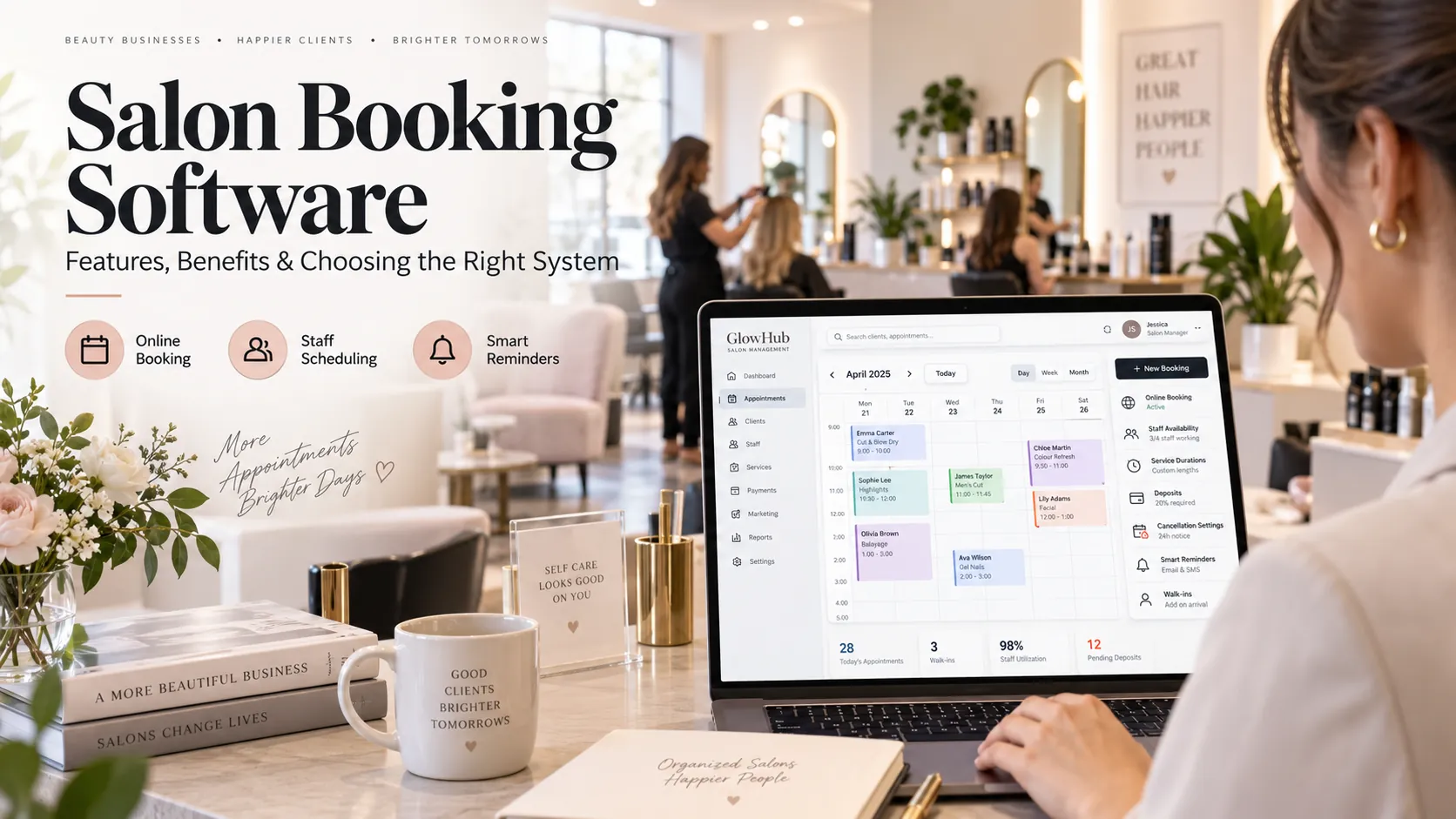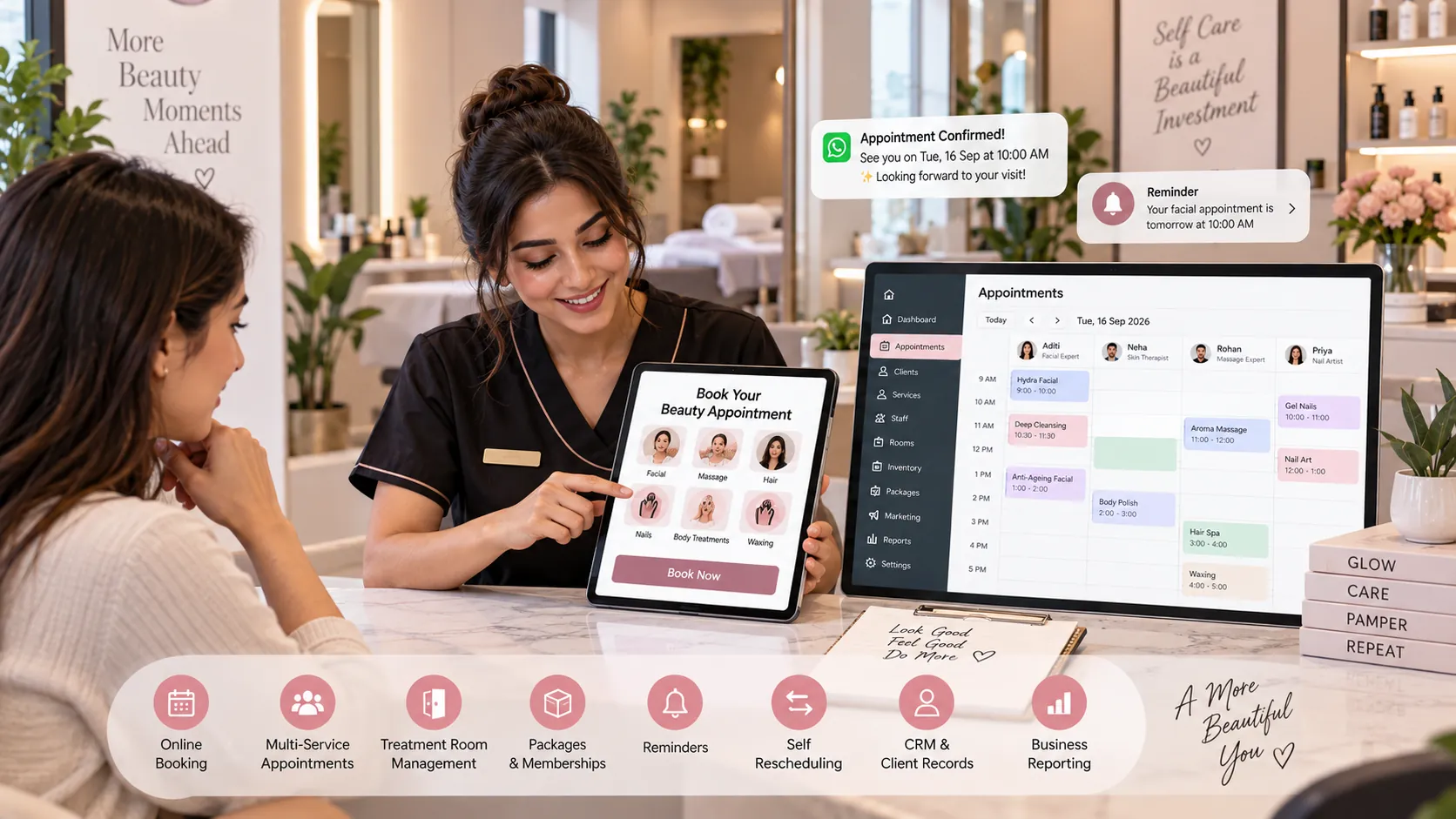
Beauty salon booking software lets customers and staff reserve appointments while checking therapist skills, service duration, treatment rooms, equipment and business rules. The strongest systems also support multi-service visits, deposits, packages, reminders, self-rescheduling and CRM.
Key takeaways
What does beauty salon booking software do?.
Why room capacity matters.
Multi-service visits should be handled as one customer journey.
Online booking UX for beauty customers.
Staff selection.
Beauty services create an unusual booking challenge: a customer may want several treatments in one visit, and each treatment can depend on a different professional or room.
A facial may require a treatment room. Threading may need only a beauty station. A manicure needs a nail technician and station. A skin treatment may require specialist equipment.
If a booking system checks only whether a staff member is free, it can create appointments the salon cannot actually fulfil.
That is why beauty salon booking software should be evaluated on resource logic and multi-service flow, not just on whether it provides an online calendar.
What does beauty salon booking software do?
A beauty booking system turns service rules into bookable availability.
The platform can consider:
service duration;
therapist or beautician skills;
working hours;
leave;
treatment rooms;
beauty stations;
equipment;
preparation and cleanup;
packages;
deposits;
cancellation policy;
branch hours.
Customers see the final valid slots.
Reception sees the operational detail behind them.
This separation keeps the booking experience simple while protecting the salon.
Why room capacity matters
Beauty salons frequently have more staff than specialised rooms.
For example, two therapists may be free at 4:00 PM, but only one facial room is available.
If the software reserves the therapist but ignores the room, the second appointment becomes a conflict.
Room scheduling is therefore not an “advanced” feature for many beauty businesses. It is basic availability.
During a trial, create two bookings that need the same treatment room and verify the system blocks the second.
Then move one booking and check that the resource is released immediately.
Multi-service visits should be handled as one customer journey
Beauty customers often combine treatments.
A customer may book:
waxing;
facial;
threading;
manicure.
The services may use different staff and different locations inside the salon.
A good booking system should help create a logical sequence.
It should avoid situations where the customer is booked for the manicure before the facial ends or must wait 45 minutes because the next therapist is unavailable.
Ask whether the software supports service combinations, packages or “appointment blocks” while still preserving each service for staffing and billing.
Online booking UX for beauty customers
A mobile booking page should help customers choose without turning the service menu into a technical catalogue.
Use:
clear service categories;
customer-friendly names;
short descriptions;
duration;
price or starting price;
preparation guidance where useful;
“not sure” or consultation options.
Avoid exposing internal codes.
If customers frequently book the wrong service, that is often a service-menu design problem rather than a customer problem.
Staff selection
Not every customer needs to select a specific beautician.
Useful options include:
Specific professional for loyal clients.
Any available professional for speed.
Gender preference where your business legitimately offers this option and local practice requires it.
Skill-based selection for specialist services.
The system should always filter to qualified staff.
It should not show a customer a professional who cannot deliver the selected treatment.
Packages and booking eligibility
Beauty salons commonly sell treatment packages.
Booking software becomes more useful when package information is available at the moment of booking.
For example, a client with four remaining facial sessions should be able to book an eligible facial without reception checking a spreadsheet.
The system should understand:
package balance;
eligible services;
expiry;
location restrictions;
customer identity;
redemption at completion.
Be careful not to redeem the session at booking if your policy requires redemption only after the treatment is completed.
Deposits for high-value appointments
Deposits can protect long-duration services or appointments that require special preparation.
Possible candidates include:
bridal makeup;
advanced skin treatments;
long packages;
specialist services;
peak-time blocks.
Use a clear rule.
The customer should know:
amount;
cancellation deadline;
whether the deposit transfers when rescheduled;
whether it is applied to the final bill.
Software should make these decisions easy for reception to understand.
Reminders and preparation instructions
Some beauty treatments require preparation.
A booking confirmation or reminder can include:
arrival time;
treatment instructions;
patch-test requirement;
documents or consultation information;
reschedule link;
cancellation policy.
Do not send every instruction to every customer.
Service-specific communication feels more useful and reduces message fatigue.
WhatsApp booking workflows
Beauty salons in India often receive booking enquiries through WhatsApp.
A practical workflow is:
customer asks a question on WhatsApp;
staff shares the structured booking link or creates the booking;
confirmed appointment enters the salon calendar;
WhatsApp is used for confirmation and reminder;
any reschedule updates the central appointment record.
This avoids maintaining a “WhatsApp diary” alongside the real booking system.
If your platform supports WhatsApp automation, check whether messages are tied to the appointment status rather than sent from static lists.
Customer self-rescheduling
Self-rescheduling can save significant reception time.
But the system must check:
notice period;
staff skill;
room;
duration;
deposit;
package;
branch;
preparation restrictions.
Customers should not be able to move a treatment into a slot reception would reject.
Waitlists for premium time slots
A waitlist helps capture demand for evenings, weekends or popular therapists.
Store enough information to match a cancellation:
preferred service;
acceptable dates;
acceptable times;
staff preference;
contact channel.
When a suitable slot becomes available, the team can contact the right customers instead of calling the entire database.
Booking data should feed the CRM
The booking record should help build a usable client profile.
Over time, the salon can see:
services used;
treatment frequency;
preferred professional;
package activity;
cancellation behaviour;
future booking;
spend;
marketing consent.
This makes retention campaigns more relevant.
For example, customers who completed a facial but have no future booking can be handled differently from customers who already rebooked.
Buying checklist
Test these scenarios before choosing beauty salon booking software:
Two therapists, one room
Does the system recognise the room bottleneck?
One customer, three services
Can it sequence them?
Therapist leave
Does online availability change?
Package holder
Can the customer book an eligible treatment correctly?
Deposit
Does it stay attached after rescheduling?
Service change
Can reception change the treatment without losing history?
Mobile booking
Can a first-time customer complete the flow comfortably?
Cancellation
Is the slot released immediately?
Waitlist
Can staff find people who wanted the newly available time?
Data export
Can you retrieve bookings and customer records?
Implementation order
Start with service and resource design.
Create consistent service names.
Then define:
duration;
eligible staff;
room;
equipment;
buffer;
online-booking eligibility;
deposit;
package eligibility.
After that, configure customer communication and cancellation policy.
Test the top 20 most common booking patterns before making every service bookable online.
This prevents the booking engine from becoming a public version of an unfinished setup.
Metrics to review
Useful beauty booking metrics include:
bookings by channel;
room utilisation;
therapist utilisation;
cancellation rate;
no-show rate;
self-reschedule rate;
package bookings;
repeat booking;
booking lead time;
demand by day;
demand by service.
Look for constraints.
If therapists are available but rooms are full, hiring more staff will not solve the problem.
That is the kind of operational insight good booking data can reveal.
Should every beauty service be instantly bookable?
No.
Some services are too variable to confirm accurately without consultation. Advanced skin treatments, bridal work, corrective services or services that depend on a patch test may need a different path.
You can use:
consultation booking;
booking request rather than instant confirmation;
staff approval;
service questionnaire;
“starting from” pricing;
pre-visit call.
The important point is to match the digital promise to what the salon can reliably deliver.
If customers regularly book the wrong service and reception has to call them back, the online menu is creating work rather than removing it.
How booking design affects conversion
A beauty salon may spend heavily on Google Ads, Meta Ads or local social content. If the booking flow is confusing, that traffic leaks.
Review the booking journey as a marketer would:
Is the booking link visible?
Does it open quickly?
Are services grouped logically?
Can a new customer understand the names?
Is pricing clear enough?
Can the customer see a useful time before entering too much data?
Is the confirmation immediate?
Can they add the appointment to their calendar?
A strong booking experience does not need aggressive persuasion. It needs to remove uncertainty.
Permissions for booking changes
Reception, managers and service staff may need different controls.
A therapist may need to view their calendar but not edit every booking. Reception may be allowed to reschedule but not waive deposits. Managers may override policy.
Define those permissions deliberately.
This makes it easier to investigate changes and prevents routine exceptions from becoming invisible.
Search and AI usefulness
This article keeps beauty salon booking software as the primary subject and answers the main follow-up questions within one page rather than creating thin pages for minor keyword variations. For stronger visibility over time, add original screenshots, workflow diagrams, verified customer examples and first-party benchmarks when available. Those assets give readers information that generic summaries cannot reproduce.
Frequently asked questions
What is beauty salon booking software?
It is software that manages beauty appointments by connecting services, staff, treatment rooms, booking rules and customer information.
Can one customer book multiple treatments?
A suitable platform should support multi-service appointments or an equivalent workflow. Test this before buying.
Can it manage treatment rooms?
Many salon-specific systems can reserve rooms or resources. Confirm whether the feature works with online booking.
Should beauty salons take deposits?
Deposits can be helpful for high-value or long services. Use them selectively and make the policy clear.
Can customers reschedule online?
Yes, if the platform supports self-service and applies the same booking rules as reception.
Does booking software replace CRM?
No. Booking creates customer activity; CRM organises the relationship and history around that activity. The two should be connected.
Final thoughts
The best beauty salon booking software protects both sides of the appointment.
Customers get a convenient way to book.
The salon keeps control over staff, rooms, timing and policies.
When those two goals are balanced, online booking reduces work instead of creating a new source of scheduling problems.