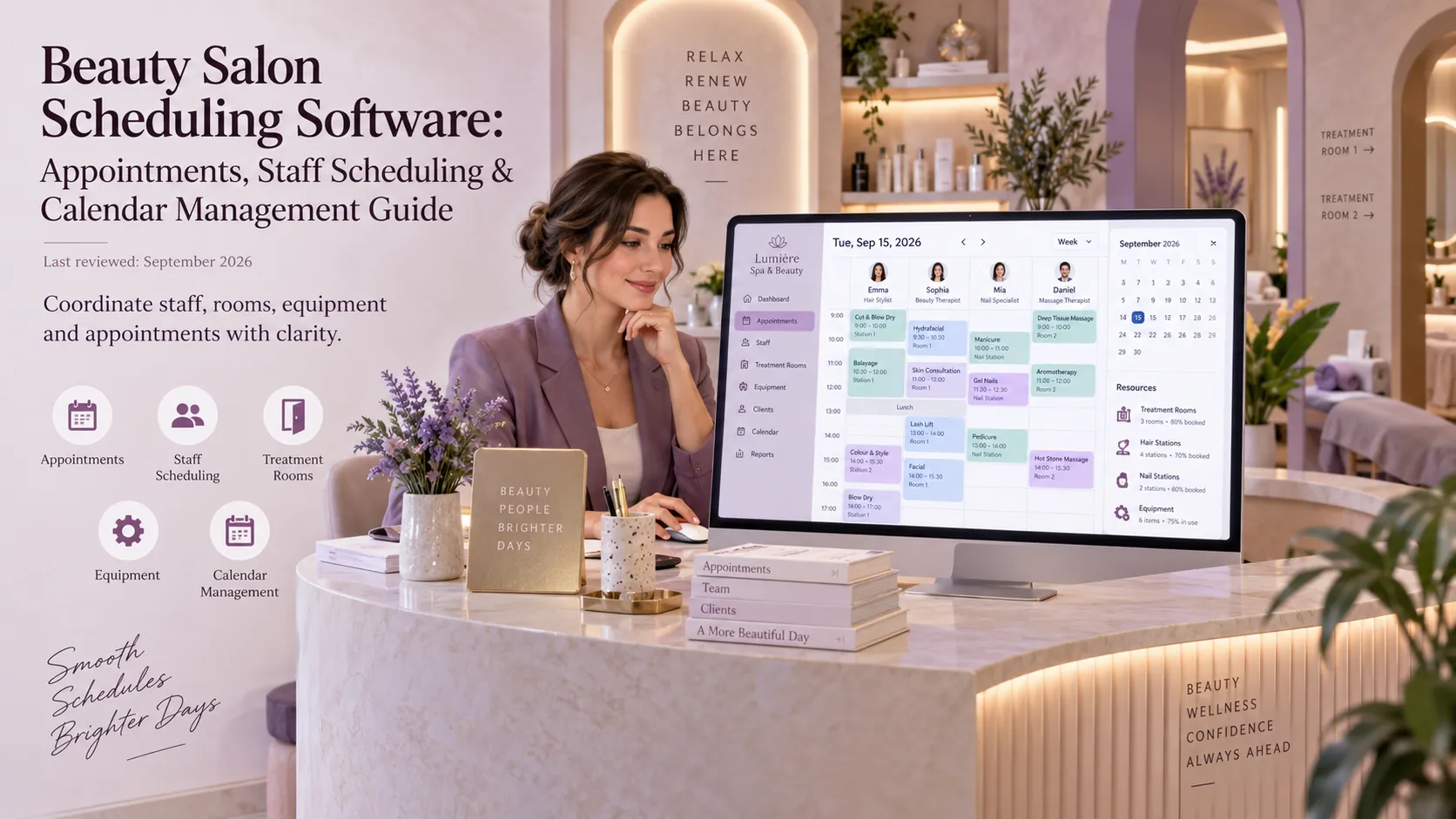
Beauty salon scheduling software manages staff availability together with treatment rooms, stations, equipment, service duration and customer appointments. It helps reception build a realistic day, prevents resource conflicts and shows where the business has usable capacity.
Key takeaways
Start with the service-resource map.
Staff schedules.
Skill-based scheduling.
Treatment-room scheduling.
Equipment scheduling.
Beauty salon scheduling is often constrained by something other than staff.
A therapist may be available but the treatment room is occupied. A manicure technician is free but the nail station is not. An advanced service may require a machine used by another client.
That makes beauty salon scheduling software a resource-management tool.
Start with the service-resource map
Before choosing software, list your main services and the resources each needs.
Example:
Service
Staff
Resource
Buffer
Facial
Therapist
Treatment room
10 min
Waxing
Beautician
Beauty room/station
5 min
Manicure
Nail technician
Nail station
5 min
Skin treatment
Qualified therapist
Device + room
15 min
This simple exercise reveals what the calendar needs to understand.
If the software cannot represent your important resource constraints, online availability will be unreliable.
Staff schedules
Each staff member needs:
working hours;
breaks;
leave;
branch;
service skills;
permissions.
Shift data should affect bookable time automatically.
If the manager approves leave in one part of the system and still has to block the appointment calendar manually, the workflow is disconnected.
Skill-based scheduling
Beauty services can require specialist training.
Do not make every staff member bookable for every treatment simply because they are in the same role.
Create service eligibility.
This protects customers and makes online booking safer.
It also makes staffing analysis more meaningful because the owner can see capacity by skill, not just by headcount.
Treatment-room scheduling
Rooms can become the main bottleneck.
A scheduling system should reserve a room when the service is booked.
Useful room features include:
room type;
eligible services;
branch;
cleaning buffer;
availability;
maintenance blocks.
If several rooms are interchangeable, the system may be able to assign any suitable one automatically.
If a treatment needs a specific room, that rule should be explicit.
Equipment scheduling
Advanced beauty services may depend on limited equipment.
Treat expensive or scarce equipment as a resource.
The calendar should stop the business from booking the same device for two clients at once.
Equipment maintenance should also remove it from availability.
This is a good example of why “staff is free” does not always mean “service is available.”
Multi-service scheduling
Beauty clients often combine services.
The calendar needs to distinguish:
total customer visit time;
time with each professional;
room use;
transition time.
For example, a customer may have a facial and manicure with different staff.
The system should sequence the services so the customer does not wait unnecessarily and the staff schedule remains accurate.
During a demo, ask the vendor to create a combined visit and then move only one service.
Preparation and cleanup
Treatments may need preparation and room turnover.
Schedule buffers for:
sanitisation;
equipment reset;
product preparation;
changing linens;
consultation.
Do not rely on reception to remember these gaps.
A calendar that books every room back-to-back without cleanup time may look efficient on paper and fail in reality.
Customer lateness
Late arrivals can create a chain reaction.
The schedule should help staff see:
how late the client is;
whether the service can still fit;
what next booking is affected;
whether another staff member or room is available.
The business policy decides what to do.
The software should make the consequences visible.
Staff breaks and workload
Scheduling is not only about filling capacity.
Beauty work can be physically demanding.
Protect realistic breaks.
Use the system to review whether certain staff are repeatedly scheduled without recovery time or receive an unbalanced service mix.
Healthy scheduling reduces burnout and improves the consistency of customer experience.
Recurring appointments
Regular services can benefit from recurring booking.
However, future occurrences should still check:
staff leave;
holidays;
room availability;
changed shifts;
changed service duration.
A recurring series is not a licence to create future conflicts.
Walk-ins
Short beauty services may generate walk-in demand.
The scheduling system should help reception identify genuine gaps.
Ask:
Which qualified person is free?
Which station is free?
How long until the next appointment?
Is there enough time for cleanup?
This is better than choosing the staff member whose calendar simply looks emptiest.
Scheduling and packages
Packages create another layer of context.
A customer may be eligible for a service but still need the same staff and resource constraints as any other appointment.
Package entitlement should not override scheduling logic.
The platform should connect the package to the customer while treating the appointment normally in the capacity model.
Scheduling dashboard for the manager
The manager needs a quick view of:
staff working;
room occupancy;
equipment conflicts;
cancellations;
waiting customers;
late-running appointments;
gaps during peak demand.
A dashboard should surface exceptions.
The front desk uses the detailed calendar. The manager uses the summary to decide where intervention is needed.
What to test before buying
Room conflict
Book the same room twice.
Equipment conflict
Reserve the same machine.
Skill conflict
Choose an unqualified staff member.
Multi-service
Create one customer visit with three services.
Break
Attempt to book during lunch.
Staff leave
Remove a therapist after appointments exist.
Late service
Extend a treatment and see the downstream impact.
Walk-in
Find the next realistic slot.
Recurring appointment
Create future visits across leave.
Mobile
Ask a staff member to view the day from a phone.
The system should either prevent the conflict or make the required override explicit.
Scheduling metrics
Review:
therapist utilisation;
room utilisation;
equipment utilisation;
peak-hour demand;
appointment overruns;
cancellations;
no-shows;
walk-in conversion;
unused peak capacity;
repeat scheduling.
Compare resources.
If therapists have spare hours while rooms are fully occupied, the constraint is physical capacity.
If rooms are empty while customers cannot get appointments, the constraint may be skill or roster design.
Implementation sequence
standardise services;
assign duration;
map staff skills;
create rooms and equipment;
add buffers;
enter shifts and leave;
configure online booking;
test combined services;
train reception;
monitor scheduling exceptions.
Avoid using permanent manual blocks to compensate for weak service configuration.
If staff repeatedly create blocks for cleanup or preparation, turn that behaviour into a formal scheduling rule.
Scheduling prepaid packages
A prepaid package can create hidden future demand.
If a salon sells a six-session treatment plan, those future sessions will eventually consume therapist and room capacity even if they are not booked yet.
Management should monitor:
active package holders;
remaining sessions;
expiry;
typical redemption interval;
future bookings.
This does not mean reserving capacity months in advance automatically. It means understanding that package sales create an operational commitment.
Scheduling and package data together give the owner a better view of future workload.
When to allow manual overrides
There will be legitimate exceptions.
A manager may decide to squeeze in a regular client, use an alternative room or shorten a buffer.
The software should support authorised overrides while recording who made the change.
A warning with a manager override is often better than a system that either blocks everything or allows every staff member to ignore rules.
Review repeated overrides.
If the same exception happens every day, the configuration is probably wrong.
Scheduling across more than one branch
Beauty chains may share staff across nearby branches.
The calendar must consider travel time and prevent a therapist from being booked in two locations.
Branch-aware scheduling should also respect:
branch opening hours;
local services;
room availability;
staff permissions;
price differences.
A multi-location label is not enough. Test a cross-branch staff schedule during the demo.
Use demand patterns to redesign shifts
Scheduling data becomes more valuable when it changes the roster.
Instead of using the same staffing pattern every day, compare demand by service, weekday and hour.
You may discover that facial demand peaks on weekends, nail appointments rise after work, or a specialist room sits unused on weekday mornings.
Managers can then adjust shifts, stagger breaks or move specialist availability closer to customer demand.
Make changes gradually and compare the result.
The goal is not to eliminate every quiet hour. It is to align the expensive parts of capacity—skilled people, rooms and equipment—with the demand the salon can realistically capture.
Why accurate service duration matters
If the configured duration is consistently shorter than real service time, the entire day runs late.
If it is too long, the salon hides sellable capacity.
Review services that frequently overrun or finish early. Adjust duration based on observed patterns, and use different timing for staff levels when the difference is meaningful.
Search and AI usefulness
This article keeps beauty salon scheduling software as the primary subject and answers the main follow-up questions within one page rather than creating thin pages for minor keyword variations. For stronger visibility over time, add original screenshots, workflow diagrams, verified customer examples and first-party benchmarks when available. Those assets give readers information that generic summaries cannot reproduce.
Frequently asked questions
What is beauty salon scheduling software?
It is software that coordinates beauty appointments with staff schedules and physical resources such as rooms or equipment.
Can it prevent room double booking?
A resource-aware system should reserve the room and prevent conflicting appointments.
Can it manage multi-service visits?
Many systems can, but the depth varies. Test a real combined booking during the demo.
Can staff see their own schedule?
Most modern platforms support staff calendar access. Use permissions to limit commercial data.
Should cleaning time be added to services?
If room turnover affects the next booking, configure a buffer instead of relying on memory.
What is the most important scheduling metric?
There is no single metric. Compare staff utilisation, room utilisation and customer demand to find the real constraint.
Final thoughts
The best beauty salon scheduling software understands that capacity is shared across people, rooms, equipment and time.
When the system models those constraints correctly, reception can trust the calendar, customers get more accurate availability and managers can see where growth is actually limited.