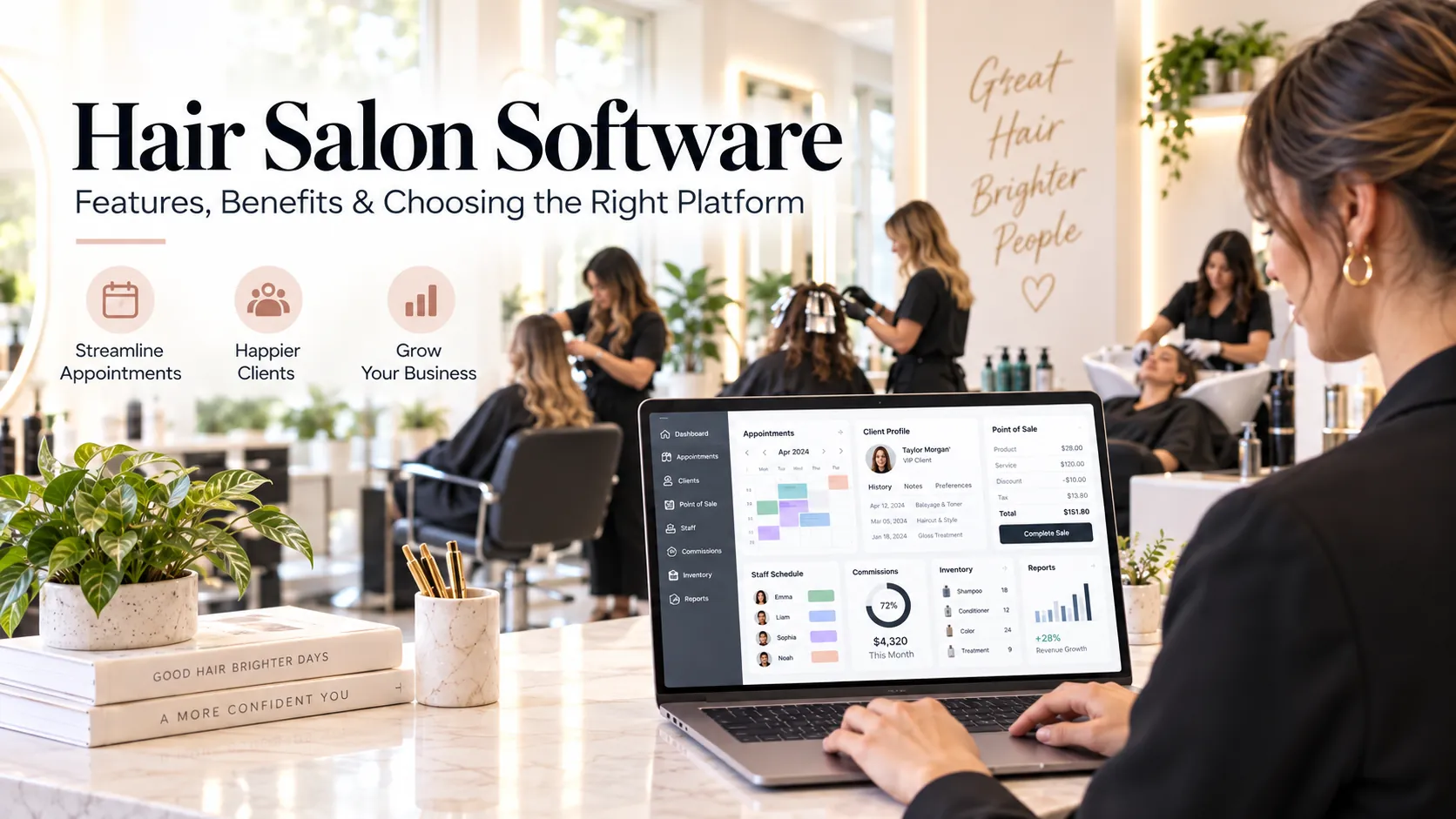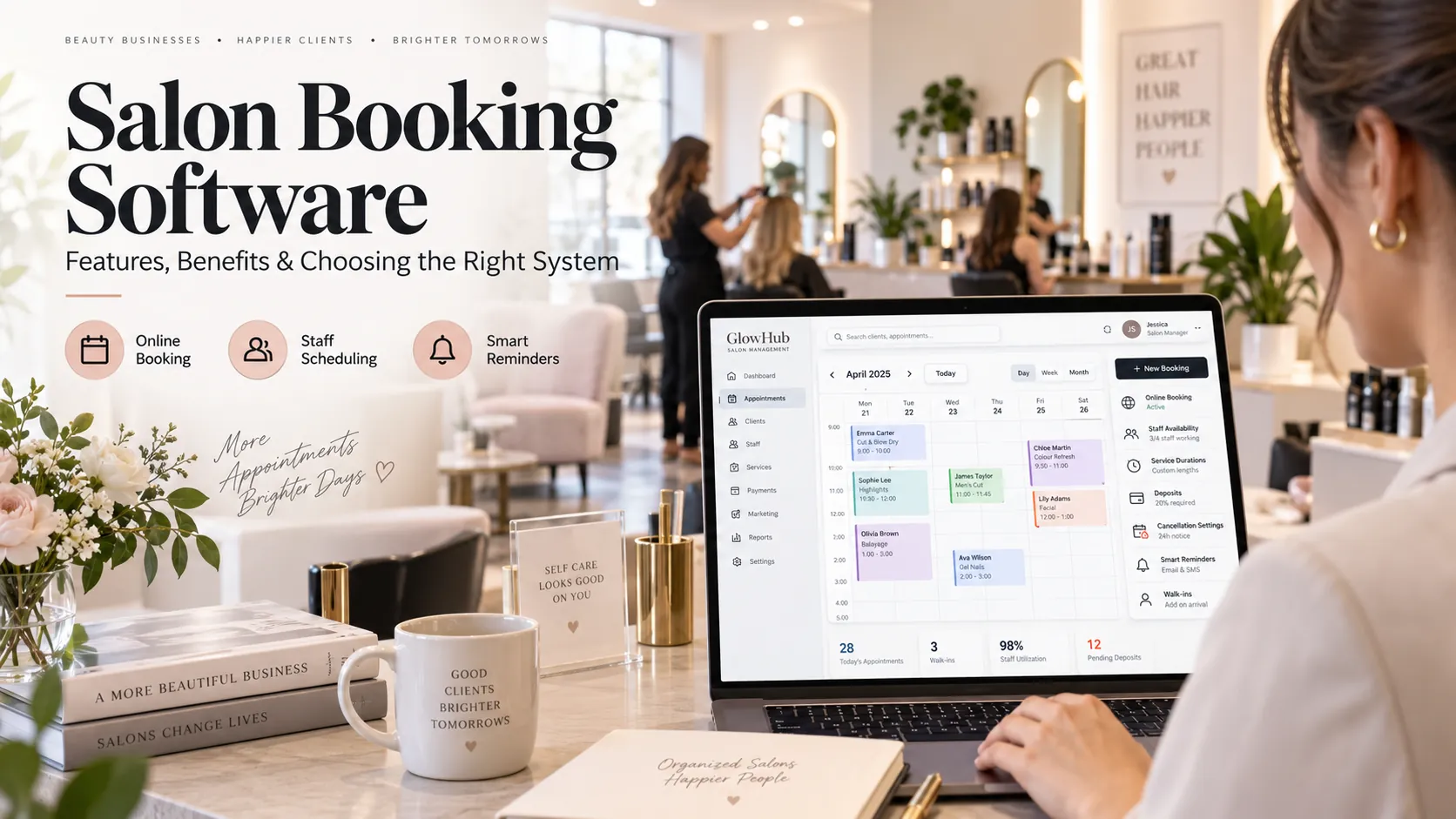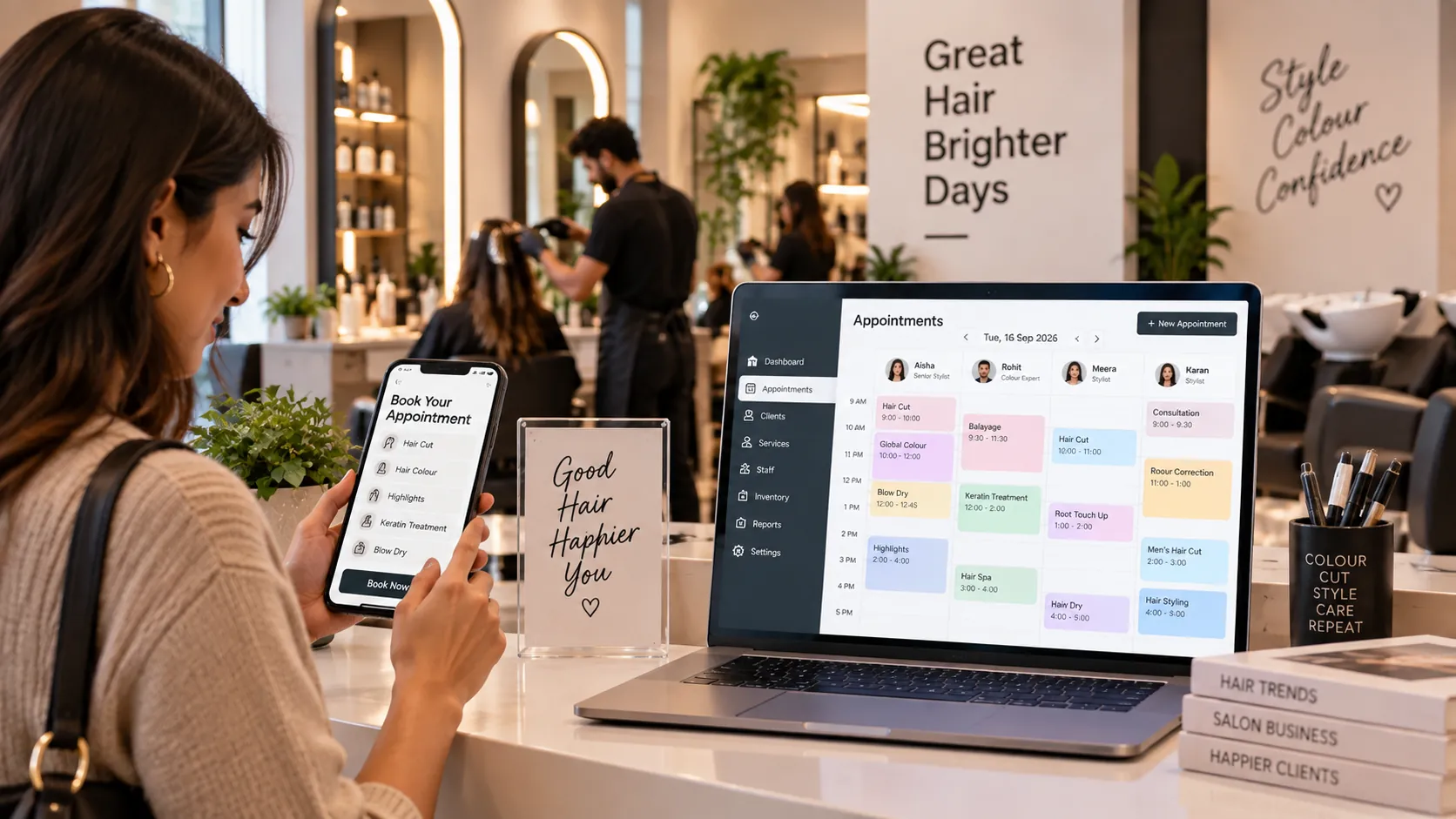
Hair salon booking software lets customers and staff create appointments while checking stylist availability, service duration, skills and salon resources. For hair businesses, the strongest systems can also handle colour processing, assistants, wash stations, deposits, reminders and repeat-service booking.
Key takeaways
What hair salon booking software should understand.
Service selection needs clear language.
Stylist selection: preferred professional vs any available.
Colour processing is the real test.
Online booking should not expose the entire diary.
Hair appointment booking looks simple only when every service fits neatly into one block.
Hair salons rarely work that way.
A colour client may need 30 minutes of active stylist time, 40 minutes of processing, a wash station, then another 30 minutes for finishing. A haircut may take a senior stylist 45 minutes and a junior stylist 60. A blow-dry can turn into an add-on treatment after consultation.
That makes hair salon booking software a capacity tool as much as a customer convenience.
What hair salon booking software should understand
The booking engine needs to know more than whether a stylist has an empty gap.
It should understand:
service duration;
staff skills;
staff-specific duration where relevant;
processing time;
assistant involvement;
wash stations or chairs;
breaks;
working hours;
branch;
online booking rules;
deposits;
cancellations.
Customers do not need to see all of that complexity.
They should see a simple set of valid options.
The software’s job is to hide the operational logic behind a clean customer journey.
Service selection needs clear language
Hair service menus can be confusing online.
Customers may not know the difference between “global colour,” “root touch-up,” “balayage,” “toner,” or “creative colour” in the same way a stylist does.
A strong booking experience uses:
clear service names;
short descriptions;
starting prices where pricing varies;
duration;
consultation guidance;
“not sure” options where appropriate.
If a service requires assessment before a price or duration can be confirmed, say so.
Do not force the booking engine to pretend the service is more standardised than it really is.
Stylist selection: preferred professional vs any available
Hair customers often build strong relationships with individual stylists.
The booking flow can support:
Preferred stylist. The customer chooses a specific professional.
Any available. The system offers the earliest suitable person.
Skill-based matching. The platform shows only staff qualified for the selected service.
Giving all three options can balance loyalty with availability.
It can also help new customers discover capacity outside the busiest stylist’s calendar.
Colour processing is the real test
If you are evaluating booking software for a hair salon, test a colour appointment.
A sophisticated model may distinguish:
application time;
processing time;
wash;
toner;
finishing.
The stylist may be able to serve another customer during part of processing.
The software may also need to reserve a chair or wash station at a later point.
Not every salon needs this level of scheduling. But if colour is an important revenue category, simplistic booking can either underuse capacity or create overlaps.
Ask the vendor to show the exact workflow.
Online booking should not expose the entire diary
A common mistake is assuming every technically empty slot should be bookable.
The salon may want to protect:
lunch;
training;
same-day cut-off;
consultation time;
high-value appointments;
closing time;
selected staff;
colour capacity;
buffer between complex services.
Booking software should convert business policy into customer availability.
That is different from showing the raw calendar.
Deposits for hair appointments
Deposits can make sense when the appointment has high value or blocks significant stylist time.
Common examples include:
colour;
extensions;
keratin;
bridal;
special-event styling;
long treatment sessions.
Avoid making the policy more complicated than staff can explain.
The system should show the amount and terms clearly, record the payment against the booking and make refund or transfer rules transparent.
Consultation-first services
Some hair services cannot be booked accurately without consultation.
The system can handle this in several ways:
book a short consultation first;
accept a provisional service;
require the salon to approve;
allow photo/reference submission through another channel;
show a “request appointment” flow instead of instant confirmation.
Choose the approach that matches operational reality.
Instant confirmation is not always the best customer experience if the salon is likely to change the appointment afterwards.
Customer self-service
A useful booking system lets customers manage routine actions without calling reception.
Typical self-service includes:
view appointment;
confirm;
reschedule;
cancel;
pay deposit;
choose another stylist;
rebook.
Rules still matter.
A customer should not be able to move a complex colour appointment into a gap that cannot support it simply because self-rescheduling is enabled.
Reminders for hair salons
Reminder timing should match booking behaviour.
A customer who booked two months in advance may benefit from an earlier reminder than someone who booked yesterday.
Messages should include:
date;
time;
location;
booked service;
stylist if relevant;
preparation instructions if necessary;
reschedule/cancel route.
Avoid over-messaging.
The aim is clarity and action, not message volume.
Hair salon CRM integration
Booking should create or update the customer profile.
Over time, the system can connect bookings with:
service history;
preferred stylist;
average visit frequency;
colour or treatment notes where appropriate;
package balances;
future booking;
retail purchases;
rebooking rate.
This supports retention.
For example, the salon can identify colour clients whose usual return interval has passed and who have no future booking.
That is more useful than a generic mass promotion.
Booking source attribution
Hair salons may receive appointments from:
website;
Google Business Profile;
Instagram;
WhatsApp;
phone;
walk-in;
referral;
campaign.
Tracking source helps the salon understand which channels create real visits.
Do not make reception spend too much time classifying every appointment manually. Use automatic source tracking where possible.
Booking and checkout should connect
A booking is the beginning of a transaction.
At checkout, the system should already know:
customer;
service;
staff;
deposit;
package;
discounts if pre-applied.
Staff can then add retail products or service changes.
This connection improves reporting and reduces front-desk work.
Buying checklist for hair salon booking software
Test stylist skills
Choose a service only some staff can perform.
Test colour timing
Create a processing-time appointment.
Test a wash-station conflict
If relevant, reserve the station from two bookings.
Test online and reception together
Book online, then move the appointment at reception.
Test a staff absence
Mark the stylist unavailable.
Test deposit transfer
Reschedule a paid booking.
Test a service change
Turn a haircut into haircut plus treatment.
Test a no-show
Verify it stays in reporting.
Test mobile UX
Book as a first-time customer from a phone.
Test export
Confirm you can retrieve customer and appointment history.
Implementation approach
Start with the services easiest to model.
For example, haircuts, blow-dries and standard treatments may be simpler than complex colour.
Once the team trusts the booking rules, add more advanced services.
This staged rollout has two benefits.
First, it reduces online booking errors.
Second, it gives reception time to learn how the new calendar behaves before every service is exposed to customers.
What to measure
Track:
online booking adoption;
new vs repeat bookings;
stylist utilisation;
colour booking lead time;
cancellations;
no-shows;
reschedules;
rebooking;
booking source;
average time between visits.
Use these metrics to improve service setup and staffing.
Do not assume online booking success means “more online appointments.” It means more correctly structured appointments with less manual work.
How booking software can improve new-client conversion
New customers often have more questions than repeat clients.
They may not know which service to choose, how long it takes, which stylist is appropriate or whether the displayed price is fixed.
A hair salon booking experience can reduce that uncertainty with clear descriptions, consultation options, “any suitable stylist” selection and simple guidance.
This is especially important for traffic coming from Google, Instagram or paid ads. Those visitors may not know the salon well enough to call.
A confusing booking page can turn marketing spend into abandoned sessions.
Keep the path clear:
explain the service in customer language;
show realistic starting price or price logic;
offer a consultation where exact scope is uncertain;
display suitable staff and times;
ask only for required information;
confirm immediately.
Rebooking is part of booking software, not a separate process
Hair is a repeat-service category.
A customer may naturally return every few weeks or months depending on the service.
At checkout, the system should make it easy to view the appropriate future calendar and create the next visit with the preferred stylist.
If the client does not rebook, the CRM can later identify that the normal return window has passed.
This makes booking software part of retention rather than only acquisition.
A strong hair salon system therefore connects the first booking, completed service, next booking and follow-up in one customer history.
Search and AI usefulness
This article keeps hair salon booking software as the primary subject and answers the main follow-up questions within one page rather than creating thin pages for minor keyword variations. For stronger visibility over time, add original screenshots, workflow diagrams, verified customer examples and first-party benchmarks when available. Those assets give readers information that generic summaries cannot reproduce.
Frequently asked questions
What is hair salon booking software?
It is a booking platform that manages customer appointments based on hair services, stylist availability and salon rules.
Can customers choose a hairstylist?
Most systems can support stylist selection. Look for an “any available” option as well.
Can hair salon booking software manage colour processing time?
Some systems can. This is an important demo question for colour-heavy salons.
Should a salon take deposits for colour appointments?
Deposits can protect long, high-value bookings. The right policy depends on no-show risk and customer experience.
Can customers reschedule themselves?
Yes, provided the system rechecks staff, duration, resource and notice rules.
Can booking software connect to WhatsApp?
Many platforms can send WhatsApp confirmations or reminders through integrations. Check how templates, consent and costs are managed.
Final thoughts
The best hair salon booking software turns a complicated salon calendar into a simple customer experience.
The customer sees valid times.
The stylist sees a realistic day.
Reception sees the same schedule.
The owner gets cleaner booking data.
That combination is far more important than having the most colourful calendar interface.