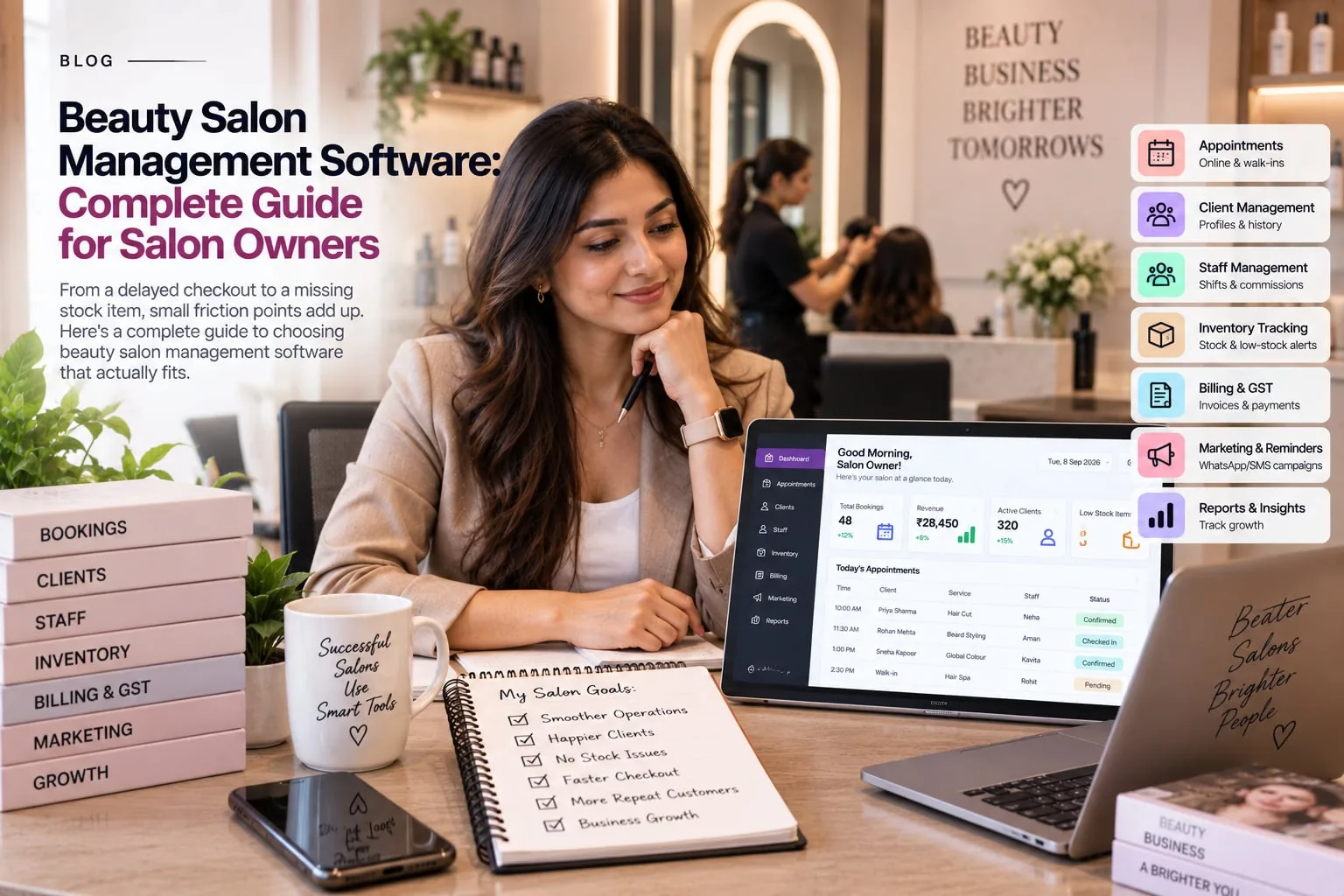
Most salon technology decisions do not fail because the software lacks buttons. They fail because the tool does not match the rhythm of the business. This guide is for salon owners and managers who are researching salon software — people who want to understand the category, judge what matters, and avoid a purchase that creates a new layer of admin instead of removing one.
Imagine a busy front desk where walk-ins, booked clients, and payment questions arrive together. The front desk needs one dependable place to understand what has happened and what comes next; switching between separate records only slows the response.
What the search term really means
Salon software is best understood as a business workflow category rather than a single feature. For salon owners and managers, the goal is to reduce double entry, missed follow-ups, and unclear staff availability while keeping the customer experience personal. A capable system should make information easier to capture once, reuse safely, and report on later. It should not force the team to become software operators at the expense of serving clients.
The scope of salon software should match the operating complexity of the salon. A solo professional may need only a small set of functions, whereas a larger team may depend on several connected modules. Buy for the business model you actually run, not for the longest feature list.
The workflow behind the software
Consider this situation: Friday evening, three clients arrive within ten minutes and one stylist is running late. A disconnected setup makes the team translate the same information between people and tools. A connected salon software workflow should preserve the booking or transaction context, show the next action clearly, and leave a trace that can be reviewed later.
This is why double entry and missed follow-ups are not merely administrative irritations. They consume attention at exactly the moment staff should be focused on the client. Reducing those small interruptions can improve consistency without making the salon feel automated or impersonal.
Where manual methods start to break
Double entry may look like a small inconvenience at low volume. Once activity increases, however, the same workaround produces duplicate checks and competing records.
Missed follow-ups have a second cost beyond time: they damage trust in shared records. Once employees keep personal notes to compensate, management no longer has one reliable version of events.
If unclear staff availability becomes routine, managers are pulled into explanation mode. A capable system should surface the exception early enough for someone to act before it turns into a recurring pattern.
A salon can tolerate occasional fragmented reporting, but it should not need a daily manual control to compensate for it. That is a sign the workflow and the operating process are misaligned.
Features worth testing in a live demo
Appointments
Do not treat appointments as a checkbox. The calendar should understand more than a start time. Service duration, staff skills, buffers, leave, and resource availability all influence whether a slot is genuinely bookable. Ask the vendor to demonstrate a normal case and an exception, because exceptions are where weak workflows usually appear.
Billing
For salon software, billing deserves a live test. Billing should connect services, products, discounts, taxes, and payment modes so the amount collected can be reconciled with the day's sales without reconstructing the story later. If staff need a spreadsheet or WhatsApp note to complete the same process, the feature is not fully connected.
Client Records
The value of client records becomes obvious only in everyday use. A useful client profile keeps visit history, preferences, notes, and commercial information together, while still giving the business sensible controls over who can see or edit it.
Memberships
A strong implementation of memberships should reduce decisions the team has to reconstruct manually. Membership and package logic needs clear balances, expiry rules, and redemption history. Ambiguity at the front desk quickly becomes a customer-service problem. The best test is whether a new receptionist can understand what happened without asking the person who entered it.
Inventory
One area to examine closely is inventory. It should reflect both retail movement and professional consumption. A salon may sell a shampoo bottle but consume colour, developer, or wax in smaller units behind the scenes.
Staff Controls
Do not treat staff controls as a checkbox. They should cover availability, permissions, and performance without turning the system into a surveillance exercise. The point is operational clarity, not micromanagement. This is also where reporting quality begins: clean operational inputs create reports that managers can trust.
Reports
For salon software, reports deserve a live test too. Reports are only useful when they lead to an action. Revenue by service, occupancy, repeat behaviour, and stock variance are more valuable than dashboards nobody discusses.
A practical Indian salon scenario
In India, the workflow should be tested with the payment and communication habits customers already use. That can include UPI, cards, cash, WhatsApp confirmations, GST-related invoicing needs, and a mix of walk-ins and scheduled appointments. A product built for another market can still work well, but the salon should validate these details instead of assuming they are covered.
Local fit is easiest to judge by watching staff use salon software in a normal shift. Frequent returns to notebooks, private WhatsApp messages, or side spreadsheets usually point to a configuration gap that deserves investigation.
How to evaluate the return
The return from salon software should be measured in operational outcomes, not login counts. A useful scorecard for this topic includes repeat visits, occupancy, average bill value, and reconciliation accuracy. Choose three or four measures before implementation and record a baseline so the owner can see whether the new process is genuinely improving the business.
The value of salon software is not limited to new sales. Cleaner handovers, fewer disputes, and more dependable records reduce management friction. Revenue gains are possible, but they come from better execution and decisions rather than from automation by itself.
Questions to ask before buying
- Can you demonstrate appointments using our own service menu rather than sample data?
- What happens when double entry occurs — can staff correct it without losing history?
- Beyond the subscription, what could we pay for messaging, implementation, integrations, additional users, or extra locations?
- If we later change platforms, which customer and transaction records can we export, in what format, and for how long will we retain access?
- Which permissions can be limited by role, branch, or responsibility?
- After launch, how are new employees trained and what support channels remain available to the salon?
A good sales demo should survive these questions comfortably. The aim is not to catch the vendor out; it is to discover whether the system can handle the ordinary exceptions that make salon operations real. For salon software, one live end-to-end workflow is more informative than twenty screenshots.
Implementation without drama
- Begin the rollout with the service catalogue. Merge duplicate services, verify prices and durations, then mark only the services that are genuinely suitable for online booking.
- Define roles before creating user accounts. Reception, service staff, managers, and owners rarely need the same level of access, so permissions should reflect responsibility from day one.
- Move only usable client data into the new system. Merge obvious duplicates, confirm active balances, and leave behind records the business no longer trusts or needs.
- Train the reception team on the handful of tasks they perform every hour before discussing advanced analytics or automation. Confidence with common actions matters first.
- For the first live days, reconcile activity daily. Compare bookings, bills, payment collections, and prepaid balances while staff still remember the transactions well enough to explain any difference.
- Once the system has been stable for several weeks, retire parallel registers that duplicate the same information. Keeping two sources of truth permanently creates the very confusion the rollout was meant to remove.
Implementation succeeds when the team understands why the process changed. Explain the customer or business problem behind each rule. People are more likely to use salon software correctly when they can see that it prevents a specific headache rather than simply satisfying management's desire for a new system.
What good usage looks like after 90 days
For this topic, Wellnito is relevant when a salon wants appointments, billing, and related workflows to sit inside the same operational environment. The useful question in a demo is not "does Wellnito have the feature?" but "can our team complete the exact scenario we just described without a workaround?" That keeps the conversation grounded in fit rather than marketing claims.
Frequently Asked Questions
Can the system work with walk-ins as well as appointments?
Yes. Salon software should accommodate walk-ins without forcing staff to misuse an appointment slot. The client still needs to be assigned correctly, billed normally, and added to history so reporting remains complete.
What should I ask during a software demo?
During the demo, use your own service menu and ask for one transaction from start to finish. Include an awkward exception, then review exports, permissions, ongoing support, and the complete cost.
How quickly can a salon team learn the system?
Core salon software tasks should become familiar after focused practice, but training quality and setup matter. Teach each role the screens it actually uses and introduce advanced functions after the everyday flow is stable.
Does salon software remove the need for staff judgement?
No. Salon software can standardise rules and present information, but judgement remains a human responsibility. Service recovery, exceptions, and relationship-building still depend on experienced staff and managers.
What data should be prepared before implementation?
Before setting up salon software, prepare the active service list, prices, realistic durations, staff details, product units, and any live prepaid balances. Cleaning duplicate customer records before import will save the team from repairing them during live operations.
Conclusion
Choosing salon software is ultimately a business-process question. The strongest salon software is the one that matches how your salon actually works, removes repeated manual steps, and gives staff enough context to serve customers confidently. Use keyword research to find the category, but use real workflows to make the buying decision. Measure the result through repeat visits, occupancy, average bill value, and reconciliation accuracy, and keep the setup simple enough that the team can follow it on the busiest day of the week.