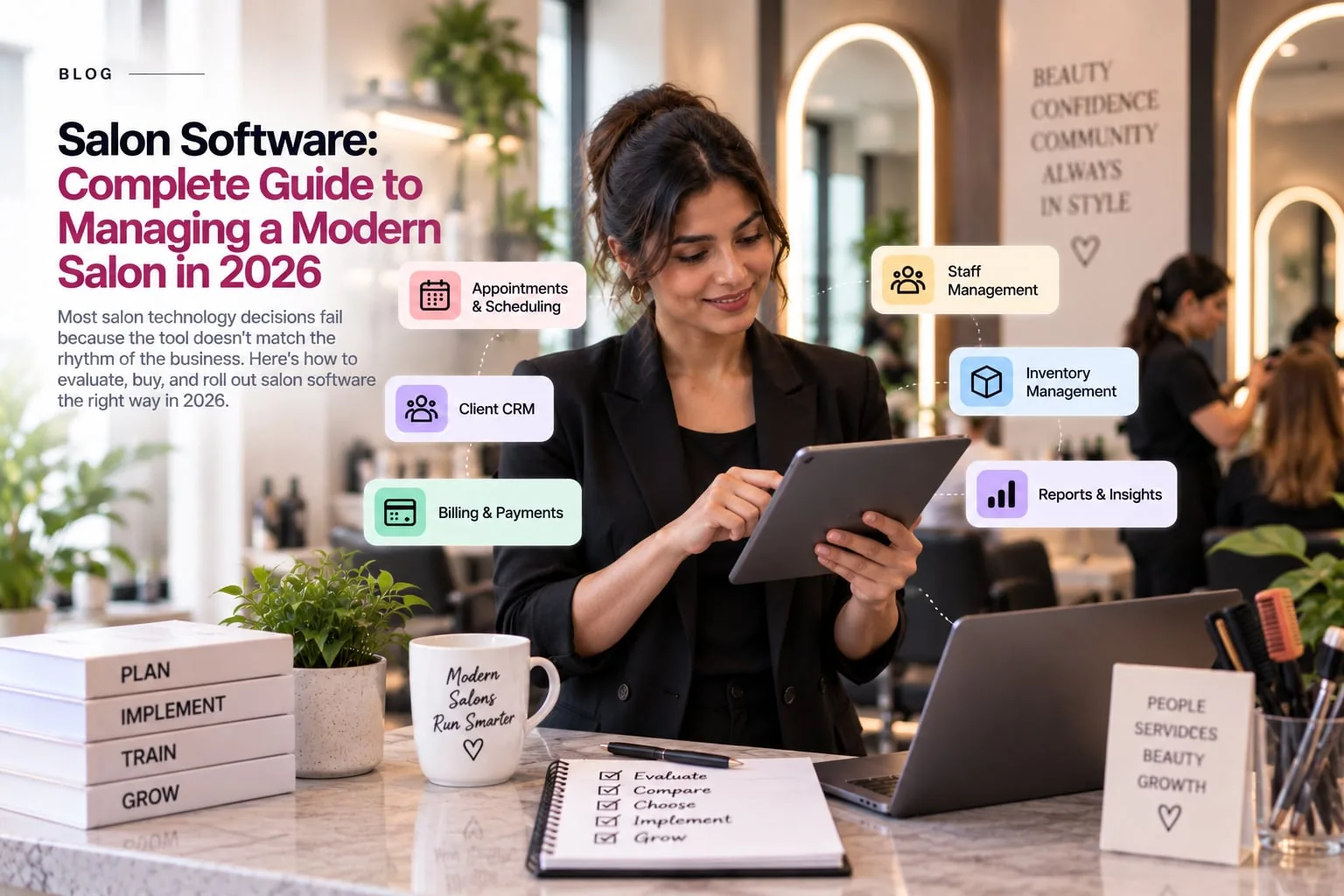
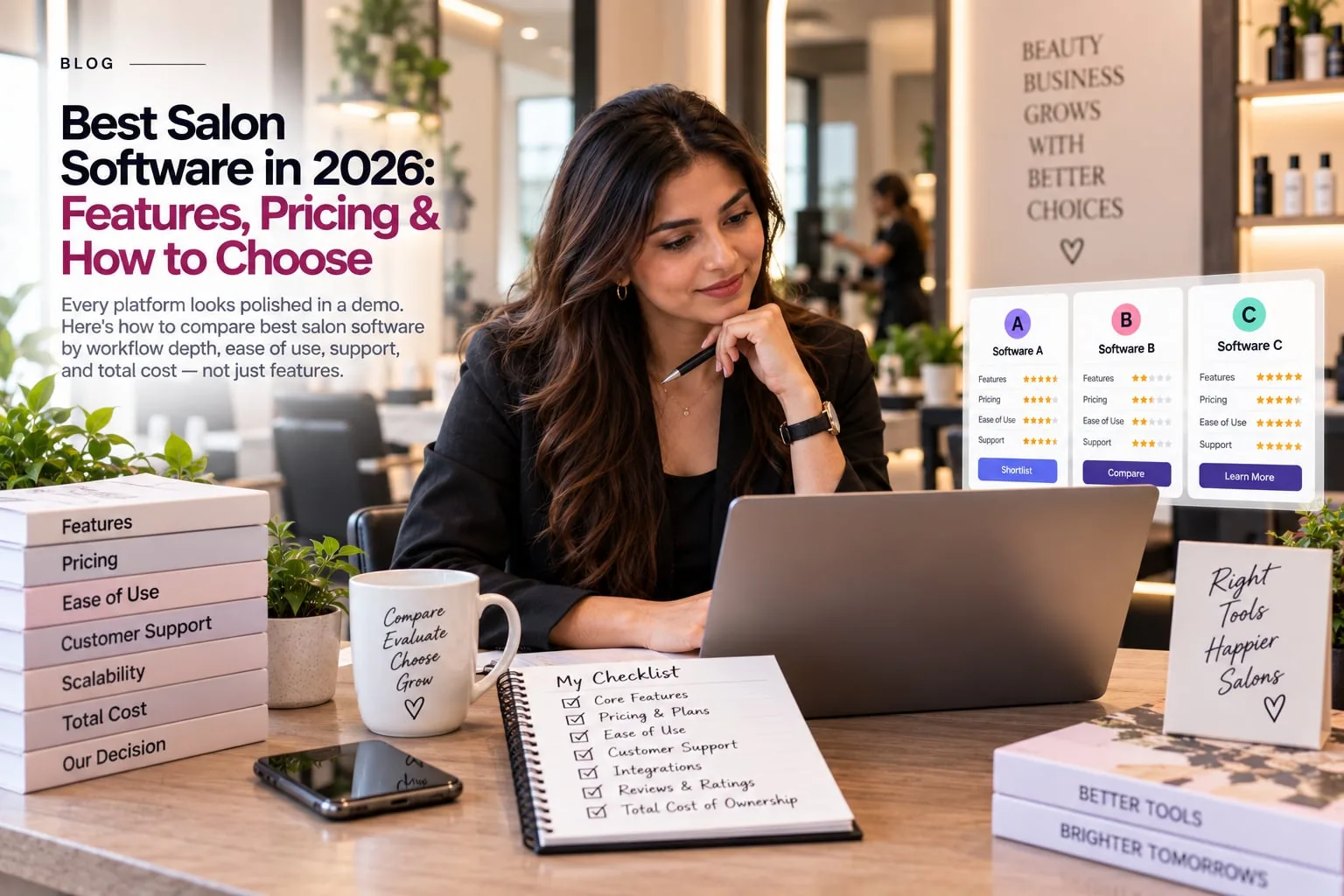
The salon industry runs on relationships, but relationships are easier to protect when operational information is dependable. This guide is for owners who need access beyond one reception computer who are researching cloud based salon software. Its search intent is mainly informational with commercial relevance: the reader wants to understand the category, judge what matters and avoid a purchase that creates a new layer of admin instead of removing one.
Use an owner checking branch performance from home while the salon continues billing and booking at the outlet as a test case. If cloud based salon software handles it cleanly, staff can keep serving clients instead of searching for the latest version of a booking, balance or note.
A day in the life of the problem
Cloud Based Salon Software is best understood as a business workflow category rather than a single feature. For owners who need access beyond one reception computer, the goal is to reduce device dependence, manual backups, version conflicts while keeping the customer experience personal. A capable system should make information easier to capture once, reuse safely and report later. It should not force the team to become software operators at the expense of serving clients.
A salon should size cloud based salon software around its actual operating model. Start with must-have jobs, then add connected capabilities only when they reduce a real handoff or control problem.
From manual workaround to connected workflow
Consider this situation: A customer says a package balance is wrong, so the team needs to explain every purchase and redemption clearly. A disconnected setup makes the team translate the same information between people and tools. A connected cloud based salon software workflow should preserve the booking or transaction context, show the next action clearly and leave a trace that can be reviewed later.
This is why device dependence and manual backups are not merely administrative irritations. They consume attention at exactly the moment staff should be focused on the client. Reducing those small interruptions can improve consistency without making the salon feel automated or impersonal.
Capabilities that matter most
A low-volume salon can sometimes absorb Device Dependence through personal attention. A busier operation cannot rely on that indefinitely, because every manual correction adds another chance for inconsistency.
When manual backups continues, the team may start treating the official system as incomplete. Personal notes then become unofficial sources of truth and handovers suffer.
Repeated version conflicts turns management into a detective function. Better controls make the deviation visible early and preserve enough context to understand the cause.
A salon can tolerate occasional limited remote access, but it should not need a daily manual control to compensate for it. That is a sign the workflow and the operating process are misaligned.
What to test with your own data
Browser Access
A strong implementation of browser access should reduce decisions the team has to reconstruct manually. Browser-based access can reduce installation friction and make the same system usable across suitable devices, provided the connection and security model are sound. A salon should be able to configure the rule once, train the team and then use it consistently across busy and quiet periods.
Central Data
One area to examine closely is central data. Central data gives an owner one source of truth instead of separate files on separate computers, which matters more as teams and locations grow. Ask the vendor to demonstrate a normal case and an exception, because exceptions are where weak workflows usually appear.
User Permissions
Do not treat user permissions as a checkbox. Cloud access increases the importance of permissions, strong passwords and disciplined offboarding when employees leave. Ask the vendor to demonstrate a normal case and an exception, because exceptions are where weak workflows usually appear.
Backups
For cloud based salon software, backups deserves a live test. Backups should be handled systematically and tested by the provider. The buyer should ask how data is protected and what recovery process exists. If staff need a spreadsheet or WhatsApp note to complete the same process, the feature is not fully connected.
Branch Visibility
The value of branch visibility becomes obvious only in everyday use. Remote branch visibility should show meaningful operating measures without forcing managers to send screenshots or end-of-day spreadsheets. If staff need a spreadsheet or WhatsApp note to complete the same process, the feature is not fully connected.
Updates
A strong implementation of updates should reduce decisions the team has to reconstruct manually. Cloud software can receive updates centrally, but buyers should still ask how changes are communicated and whether major workflow changes require retraining. The best test is whether a new receptionist can understand what happened without asking the person who entered it.
Device Flexibility
One area to examine closely is device flexibility. Device flexibility is valuable when the experience remains consistent and critical peripherals such as printers or scanners are supported where needed. The best test is whether a new receptionist can understand what happened without asking the person who entered it.
Indian operating realities to include
In India, the workflow should be tested with the payment and communication habits customers already use. That can include UPI, cards, cash, WhatsApp confirmations, GST-related invoicing needs and a mix of walk-ins and scheduled appointments. A product built for another market can still work well, but the salon should validate these details instead of assuming they are covered.
Do not judge Indian-market fit only from a feature list. Observe a busy day with cloud based salon software: repeated manual workarounds are evidence that the operating design needs adjustment.
How this affects customer experience
The return from cloud based salon software should be measured in operational outcomes, not login counts. A useful scorecard for this topic includes uptime, access reliability, support response and cross-branch data consistency. Choose three or four measures before implementation and record a baseline so the owner can see whether the new process is genuinely improving the business.
The business case for cloud based salon software includes avoided friction as well as growth. Fewer corrections and more reliable handovers matter; any revenue lift should be traced to specific changes in booking, retention, capacity or sales behaviour.
Cost, control and scalability
- Can you demonstrate browser access using our own service menu rather than sample data?
- What happens when device dependence occurs - can staff correct it without losing history?
- Can you provide an all-in estimate that includes likely user, branch, communication, onboarding and integration costs?
- Which records belong to us operationally, how can we retrieve them, and what is the offboarding process?
- Which permissions can be limited by role, branch or responsibility?
- How does the vendor support retraining, new branches or new team members after the original go-live?
A good sales demo should survive these questions comfortably. The aim is not to catch the vendor out; it is to discover whether the system can handle the ordinary exceptions that make salon operations real. For cloud based salon software, one live end-to-end workflow is more informative than twenty screenshots.
Common misconceptions
- Do not wait for the first monthly report to discover setup problems. During cloud based salon software rollout, verify a sample of bookings, package redemptions, refunds and payment totals every day.
- Review old manual trackers after the first month. If cloud based salon software now covers the job reliably, archive the redundant file rather than asking staff to update two places forever.
- Do not import a messy service list into cloud based salon software. Clean categories, remove duplicates and validate duration and pricing first; configuration is easier when the base data is trustworthy.
- Create a simple access matrix for cloud based salon software: what each role must see, what it may change and what needs manager approval. That prevents unnecessary privilege without slowing everyday work.
- Use the move to cloud based salon software to fix duplicate customers and stale balances. Staff confidence drops quickly if the new system launches with the same data problems as the old one.
- Avoid overwhelming staff with every cloud based salon software feature at launch. Start with the actions that affect customers directly, then layer in management and automation features over the following weeks.
Implementation succeeds when the team understands why the process changed. Explain the customer or business problem behind each rule. People are more likely to use cloud based salon software correctly when they can see that it prevents a specific headache rather than simply satisfying management's desire for a new system.
Decision checklist
For this topic, Wellnito is relevant when a salon wants browser access, central data and related workflows to sit inside the same operational environment. The useful question in a demo is not 'does Wellnito have the feature?' but 'can our team complete the exact scenario we just described without a workaround?' That keeps the conversation grounded in fit rather than marketing claims.
Frequently Asked Questions
What data should be prepared before implementation?
Data preparation should focus on accuracy. Confirm the salon's current menu, staff, products and active customer balances before loading them into cloud based salon software; do not import clutter simply because it exists.
How should I compare the price of two salon platforms?
A lower headline price does not guarantee lower cost. Calculate what cloud based salon software will actually require across a full year and include the internal cost of manual workarounds if a cheaper plan lacks key functionality.
What reports should an owner review every month?
For this topic, start with uptime, access reliability, support response and cross-branch data consistency. A monthly review should be short enough that managers use it consistently and specific enough to trigger a decision.
Is this type of salon software suitable for a small business?
Yes, if the workflow is simple enough to configure without adding unnecessary admin. A small salon should prioritise the two or three problems it actually has and avoid paying for complexity it will not use. Cloud Based Salon Software becomes more valuable as bookings, staff and customer history grow.
Can the system work with walk-ins as well as appointments?
Yes, provided walk-ins are treated as genuine transactions rather than off-system exceptions. cloud based salon software should show who served the client and include the visit in billing and performance reports.
Conclusion
Cloud-Based Salon Software: Why Salons Are Moving to the Cloud is ultimately a business-process question. The strongest cloud based salon software is the one that matches how your salon actually works, removes repeated manual steps and gives staff enough context to serve customers confidently. Use the keyword research to find the category, but use real workflows to make the buying decision. Measure the result through uptime, access reliability, support response and cross-branch data consistency, and keep the setup simple enough that the team can follow it on the busiest day of the week.