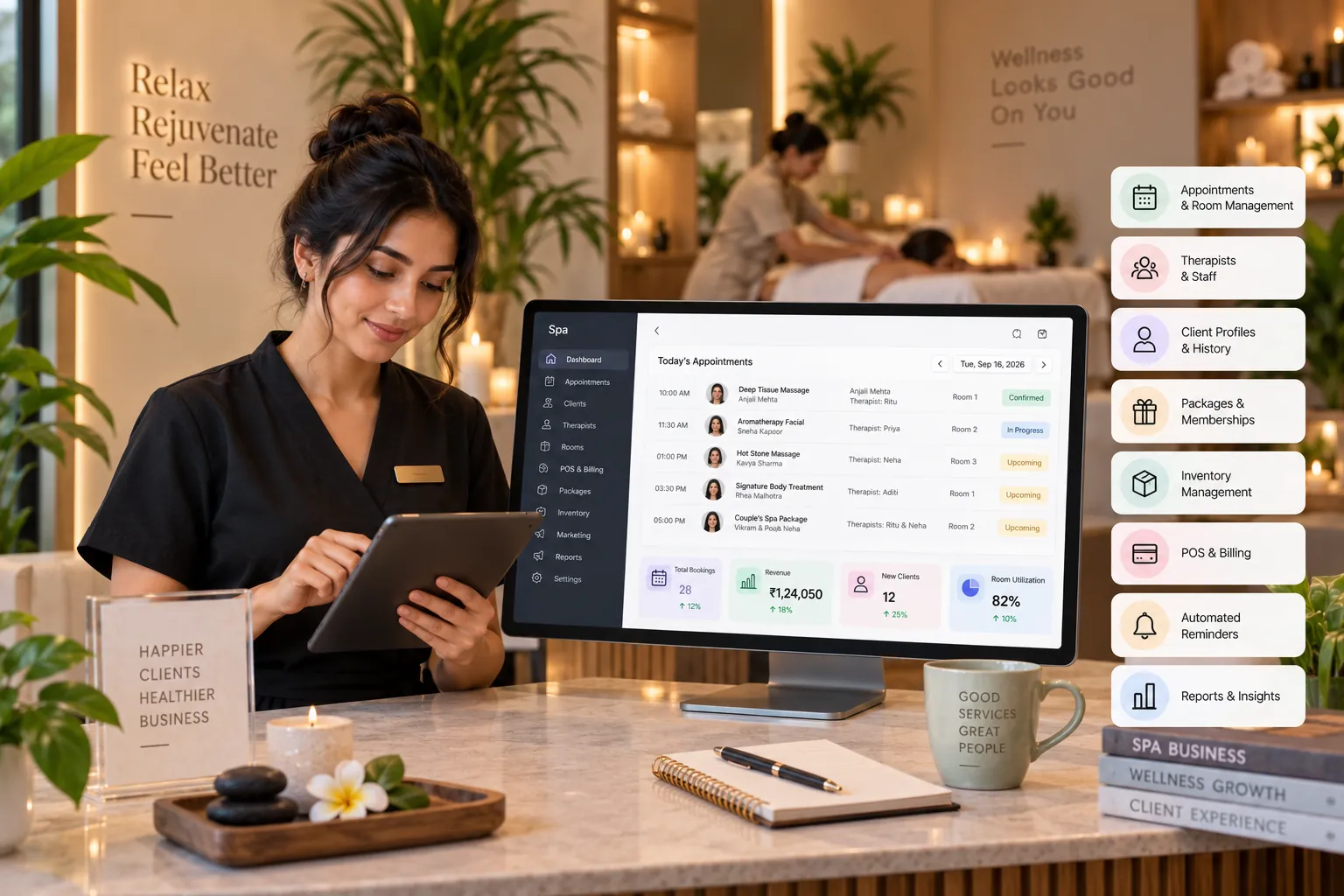
Quick answer: Spa software manages appointments, therapists, treatment rooms, client history, POS, packages, memberships, inventory, reminders and reporting. The best platform understands that spa capacity depends on both therapist time and physical treatment rooms, with preparation and cleanup around each service.
Key takeaways
- What is spa software?.
- Inventory.
- How to choose spa software.
- Staff workload and therapist wellbeing.
A spa sells time, expertise and physical treatment space together.
A therapist can be free while the appropriate room is occupied.
A room can be empty while no qualified therapist is available.
A treatment may need preparation before the customer arrives and cleanup afterwards.
That is why software for spas should be evaluated as a resource-management platform, not only a booking system.
What is spa software?
Spa software is a specialised business platform for managing spa operations.
It may include:
- online booking;
- therapist scheduling;
- room scheduling;
- intake forms;
- customer profiles;
- POS;
- packages;
- memberships;
- gift cards or vouchers;
- inventory;
- reminders;
- staff permissions;
- reporting;
- multi-location controls.
The most important capability is coordination.
The system needs to know when people, rooms and services can come together.
Therapist scheduling
Therapist availability should include:
- shift;
- leave;
- break;
- service qualification;
- branch;
- maximum workload where the business applies one.
A therapist should not automatically be available for every service.
Assign skills.
If only two therapists can perform a specialist treatment, the booking engine should reflect that.
Treatment-room scheduling
Room scheduling is fundamental.
Create room types where necessary.
For example:
- massage room;
- facial room;
- couples room;
- wet treatment room.
A service may be allowed in one or several room types.
The software should reserve a suitable room when the appointment is booked.
This prevents the common situation where therapists appear available but the spa cannot physically deliver the treatment.
Preparation and cleanup
A 60-minute treatment may consume more than 60 minutes of room capacity.
The room may need:
- setup;
- linen change;
- sanitisation;
- product preparation;
- reset.
Configure buffers.
If the spa relies on employees to add manual blocks after every booking, online availability will eventually become inaccurate.
Couples and group bookings
A couples treatment can require:
- two therapists;
- one suitable room;
- same start time;
- same duration.
This is a strong test for spa software.
Ask the vendor to create a couples massage, make one therapist unavailable, then reschedule it.
If the platform handles only single-person appointments easily, the spa may face workarounds.
Customer preferences
Spa customers may have preferences related to:
- therapist;
- room;
- pressure;
- service type;
- communication.
Store only relevant information.
Use permissions.
A customer profile should support service continuity without becoming a collection of unnecessary sensitive details.
Intake forms
Some spas use consultation or intake forms.
The platform may allow digital forms before arrival.
Evaluate:
- custom fields;
- customer consent;
- access control;
- storage;
- versioning;
- branch use.
Collect only what the business legitimately needs.
The presence of a form builder does not mean every field should be used.
Packages
Spa packages can be simple or complex.
Examples:
- six massages;
- three facials;
- wellness bundle;
- couples package.
The system should track:
- purchase;
- balance;
- expiry;
- eligible service;
- redemption;
- branch;
- refund.
Package booking must still respect therapist and room availability.
Entitlement does not create capacity.
Memberships
A spa membership may include:
- monthly treatment;
- member pricing;
- discounts;
- credits;
- rollover;
- renewal.
The platform should make the member benefit visible at booking and checkout.
Complex rules can create front-desk confusion.
Design the membership so staff and customers can understand it.
Gift cards and vouchers
Spa services are popular gifts.
If the platform supports vouchers, check:
- monetary vs service-specific value;
- partial redemption;
- expiry policy;
- branch use;
- balance;
- transfer;
- reporting.
Reception should be able to verify the balance quickly.
POS and checkout
Checkout should combine:
- services;
- packages;
- products;
- deposits;
- membership benefits;
- taxes;
- payments;
- refunds.
If the spa sells retail products, those items should update inventory.
If the customer used a package session, the balance should update at the appropriate point.
Inventory
Spa inventory may include:
- massage oils;
- skincare;
- creams;
- disposables;
- retail products;
- treatment supplies.
Track expensive or essential items more closely.
For low-value consumables, periodic counts may be more practical than service-level deduction.
The system should help prevent stockouts without creating unrealistic data-entry work.
Customer communication
Spa reminders may include preparation information.
Examples:
- arrive early;
- complete intake;
- bring specific information;
- cancellation policy;
- reschedule link.
Post-treatment follow-up can differ by service.
Avoid sending generic marketing immediately after every appointment.
Use the service history to create more relevant communication.
Spa reporting
Useful metrics include:
- therapist utilisation;
- room utilisation;
- revenue per treatment hour;
- package redemption;
- membership retention;
- cancellation;
- no-show;
- average bill;
- retail attachment;
- repeat rate;
- booking lead time.
Compare therapist and room utilisation.
The lower of the two may reveal the real capacity constraint.
AI use cases for spas
AI can help summarise:
- room utilisation;
- therapist capacity;
- package behaviour;
- customer return patterns;
- cancellation trends;
- stock anomalies.
It can also help managers ask questions in natural language.
Keep the source data available for verification.
AI should support management decisions, not hide the operational facts.
How to choose spa software
Test:
Couples booking
Can it reserve two therapists and the right room?
Room buffer
Does cleanup block the room?
Therapist skill
Can an unqualified person be prevented from booking?
Package
Can the client redeem one session correctly?
Membership
Is benefit applied at checkout?
Intake
Can forms be assigned by service?
Voucher
Can partial value be redeemed?
Refund
Is the audit trail clear?
Mobile
Can staff see the schedule without exposing unnecessary data?
Multi-location
Can customers and packages move according to your rules?
Implementation plan
- standardise services;
- define duration;
- define room type;
- assign therapist skills;
- add preparation/cleanup buffers;
- configure packages;
- configure memberships;
- import customers;
- set reminders;
- test resource-heavy bookings.
Do not publish online booking until room and therapist logic is reliable.
The spa should be confident that every slot shown is actually deliverable.
Staff workload and therapist wellbeing
Spa services can be physically demanding.
A schedule that maximises booked hours without considering service intensity may be unsustainable.
Management can review:
- back-to-back treatments;
- break compliance;
- service mix;
- therapist working hours;
- heavy-treatment distribution.
Software does not need to make wellbeing decisions automatically. It should give managers enough visibility to build a realistic roster.
Dynamic availability vs fixed menus
Not every spa service needs to be available at every time.
Availability can depend on:
- room type;
- therapist skill;
- equipment;
- daypart;
- branch.
A good booking engine derives availability from those rules.
This is better than maintaining several manual calendars or frequently calling customers back after they book.
Customer retention for spas
Spa retention can be managed around service and package behaviour.
Useful segments include:
- massage clients past their typical return interval;
- first-time clients who did not return;
- package holders with unused sessions;
- members approaching renewal;
- customers who purchase treatments but no retail products.
Use segmentation to create relevant follow-up rather than generic discount campaigns.
Revenue per treatment hour
A spa should not evaluate services only by ticket price.
Consider how much room and therapist time the service consumes.
Revenue per treatment hour can help compare services with very different durations.
Combine it with product cost, commission and repeat behaviour for a more complete view.
A lower-ticket service may be attractive if it uses capacity efficiently and drives retention.
Multi-location spas
For multiple locations, test:
- room configuration by branch;
- therapist working across locations;
- central customer profile;
- package portability;
- branch-specific membership rules;
- stock transfer;
- consolidated reports.
A platform that supports multiple locations should still let each branch have a different physical resource layout.
End-of-day spa operations
A spa manager may need a closing checklist that goes beyond sales.
Review:
- completed vs open appointments;
- payment reconciliation;
- room issues;
- stock alerts;
- package adjustments;
- therapist schedule exceptions;
- customer follow-up requiring attention.
The software can surface these exceptions so the manager does not inspect every record.
Mobile access for therapists
Therapists may need a simple mobile view of upcoming treatments, room, timing and relevant customer information.
Keep access narrow.
A therapist does not need full customer exports or financial reports to deliver a treatment.
Role-based mobile design reduces clutter and protects business data.
Data migration
Moving spa software requires special attention to prepaid value.
Before migration, reconcile packages, memberships, gift balances and future appointments. Importing an incorrect balance can create immediate customer-service problems.
Keep a snapshot of the old system and verify a sample of high-value customers before going live.
Migration quality should be part of the vendor evaluation, not an afterthought.
Search and AI usefulness
This article keeps software for spas as the primary subject and answers the main follow-up questions within one page rather than creating thin pages for minor keyword variations. For stronger visibility over time, add original screenshots, workflow diagrams, verified customer examples and first-party benchmarks when available. Those assets give readers information that generic summaries cannot reproduce.
Frequently asked questions
What is spa software used for?
It manages spa appointments, therapists, rooms, customers, billing, packages, memberships, inventory and reports.
Can spa software schedule rooms?
A suitable platform should treat rooms as bookable resources.
Can it manage couples massage?
Some systems can schedule multiple therapists and a suitable room. Test the exact scenario.
Can it send digital intake forms?
Many platforms offer forms or integrations. Check permissions and data handling.
Can it manage memberships?
Yes, in many full spa platforms. Compare billing, credits, rollover and redemption rules.
What is the most important spa metric?
Therapist utilisation and room utilisation together provide a strong view of capacity.
Final thoughts
The right software for spas understands that a spa is constrained by both people and space.
It protects treatment-room capacity, makes packages easy to manage and gives the owner a clearer picture of utilisation and retention.
That operational depth matters more than a long generic list of salon features.
Related reading
- [Salon & Spa Software: Features, Benefits & How to Choose the Right Platform](/blog/salon-and-spa-software/)
- [Salon Software: Features, Benefits & How to Choose the Right Platform](/blog/salon-software/)
- [Beauty Salon Software: Features, Benefits & How to Choose the Right Platform](/blog/beauty-salon-software/)
- [Hair Salon Software: Features, Benefits & How to Choose the Right Platform](/blog/hair-salon-software/)