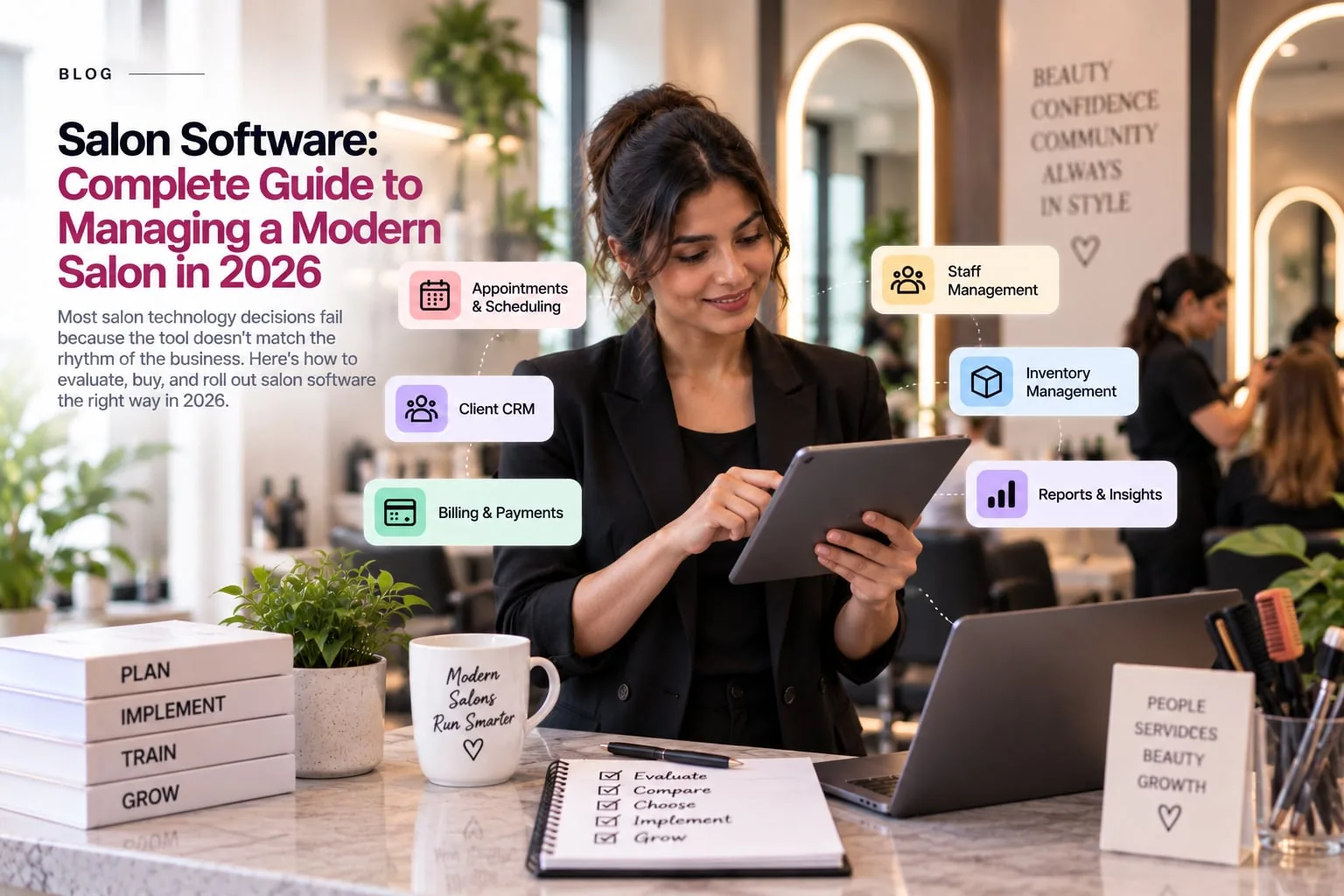
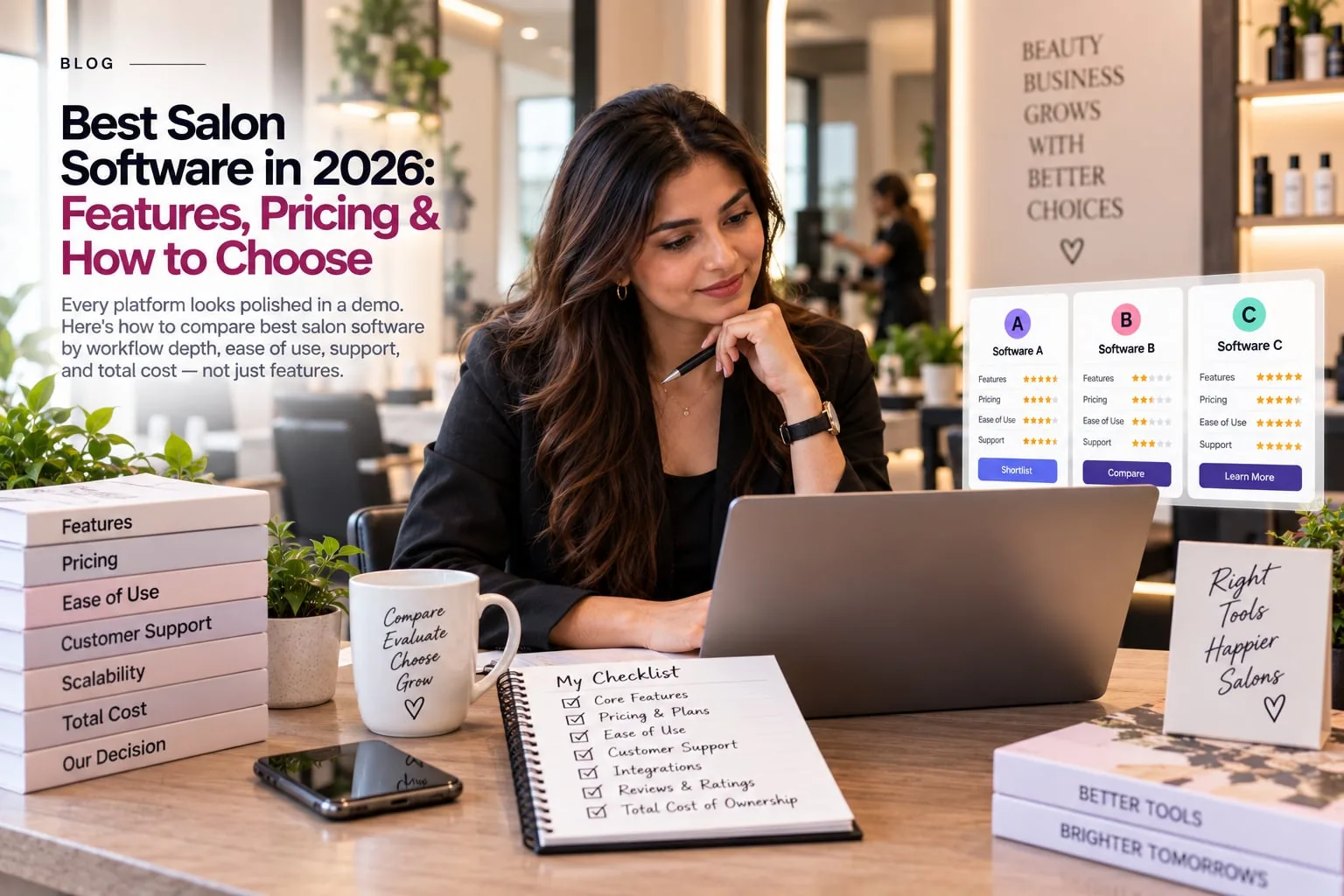
Salon owners often notice operational friction in small moments: a delayed checkout, a missed reminder, a stock item nobody can find or a client record split across two places. This guide is for spa owners and wellness managers who are researching software for spas. Its search intent is mainly informational with commercial relevance: the reader wants to understand the category, judge what matters and avoid a purchase that creates a new layer of admin instead of removing one.
Take a normal example: a treatment schedule where therapist time, room availability and service duration all have to line up. Under that pressure, the value of software for spas is continuity - the next staff member should see enough context to continue the job without reconstructing it from messages and spreadsheets.
A day in the life of the problem
Software For Spas is best understood as a business workflow category rather than a single feature. For spa owners and wellness managers, the goal is to reduce room clashes, long service buffers, package complexity while keeping the customer experience personal. A capable system should make information easier to capture once, reuse safely and report later. It should not force the team to become software operators at the expense of serving clients.
There is no universal feature boundary for software for spas. A compact studio and a multi-chair salon solve different problems, so the right configuration expands with staff count, service mix, branches and management needs.
From manual workaround to connected workflow
Consider this situation: The branch manager is closing the day while UPI settlements, cash in the drawer and two refunds need to be reconciled. A disconnected setup makes the team translate the same information between people and tools. A connected software for spas workflow should preserve the booking or transaction context, show the next action clearly and leave a trace that can be reviewed later.
This is why room clashes and long service buffers are not merely administrative irritations. They consume attention at exactly the moment staff should be focused on the client. Reducing those small interruptions can improve consistency without making the salon feel automated or impersonal.
Capabilities that matter most
Many teams tolerate Room Clashes while the business is small because it feels manageable. Growth changes the equation: more transactions mean more opportunities for the workaround to create conflicting answers.
Time loss is only part of the issue with long service buffers. If people doubt the main record, they create their own backup notes, and those private workarounds make consistency even harder.
Normalising package complexity is expensive because management time shifts from improvement to investigation. The platform should help identify the exception while it is still specific and traceable.
A salon can tolerate occasional therapist allocation, but it should not need a daily manual control to compensate for it. That is a sign the workflow and the operating process are misaligned.
What to test with your own data
Room/Resource Scheduling
A strong implementation of room/resource scheduling should reduce decisions the team has to reconstruct manually. A spa booking can require a therapist, a room and sometimes equipment. The system should reserve the complete set, not only the person. The best test is whether a new receptionist can understand what happened without asking the person who entered it.
Therapist Rosters
One area to examine closely is therapist rosters. Therapist rosters should respect specialisations, breaks and treatment intensity so the calendar remains realistic through a long shift. The best test is whether a new receptionist can understand what happened without asking the person who entered it.
Treatment Notes
Do not treat treatment notes as a checkbox. Treatment notes can improve continuity, but sensitive information should be limited to what is necessary and accessed only by appropriate roles. This is also where reporting quality begins: clean operational inputs create reports that managers can trust.
Packages
For software for spas, packages deserves a live test. Packages should solve a real operating problem and connect cleanly with the rest of the salon workflow. This is also where reporting quality begins: clean operational inputs create reports that managers can trust.
Billing
The value of billing becomes obvious only in everyday use. Billing should connect services, products, discounts, taxes and payment modes so the amount collected can be reconciled with the day's sales without reconstructing the story later. A salon should be able to configure the rule once, train the team and then use it consistently across busy and quiet periods.
Inventory
A strong implementation of inventory should reduce decisions the team has to reconstruct manually. Inventory should reflect both retail movement and professional consumption. A salon may sell a shampoo bottle but consume colour, developer or wax in smaller units behind the scenes. A salon should be able to configure the rule once, train the team and then use it consistently across busy and quiet periods.
Follow Ups
One area to examine closely is follow-ups. Follow-up works best when triggered by a real customer event: a missed appointment, an expected repeat cycle, unused package balance or feedback request. Ask the vendor to demonstrate a normal case and an exception, because exceptions are where weak workflows usually appear.
Indian operating realities to include
Indian salon operations often combine high-touch service with very practical digital habits. Customers may discover the salon on Instagram, enquire on WhatsApp, book through a link and pay by UPI. Software For Spas should connect enough of that journey to prevent the front desk from manually rebuilding the story at each step.
The clearest test of software for spas in an Indian salon is adoption during real operating pressure. If employees keep bypassing the system, look for the process mismatch before assuming the team is resistant to change.
How this affects customer experience
The return from software for spas should be measured in operational outcomes, not login counts. A useful scorecard for this topic includes room utilisation, therapist occupancy, package redemption and rebooking. Choose three or four measures before implementation and record a baseline so the owner can see whether the new process is genuinely improving the business.
Some returns from software for spas are operational rather than immediately financial: less rework, clearer ownership and faster answers for clients. Treat revenue improvement as an outcome of better behaviour, not as an automatic promise from the software.
Cost, control and scalability
- Can you demonstrate room/resource scheduling using our own service menu rather than sample data?
- What happens when room clashes occurs - can staff correct it without losing history?
- Please show the full cost model: which charges sit outside the base plan for users, branches, WhatsApp/SMS, onboarding or integrations?
- Show us the data-export process and explain what happens to our records if the subscription is cancelled.
- Which permissions can be limited by role, branch or responsibility?
- Does onboarding support continue when staff change, or is training limited to the initial implementation period?
A good sales demo should survive these questions comfortably. The aim is not to catch the vendor out; it is to discover whether the system can handle the ordinary exceptions that make salon operations real. For software for spas, one live end-to-end workflow is more informative than twenty screenshots.
Common misconceptions
- Role-based training works better than a tour of every menu. Start software for spas training with booking, customer lookup, checkout and corrections, then add advanced functions once those feel routine.
- Use a brief control period after software for spas goes live. Daily checks of sales, payment modes and key balances will expose setup issues before they become month-end mysteries.
- Do not let temporary backup spreadsheets become permanent habits. After software for spas is proven and reconciled, close down duplicate tracking methods unless they serve a separate legal or operational purpose.
- Your first setup task for software for spas should be service-menu hygiene: standardise names, check duration and price, and clearly separate bookable services from those that need a consultation.
- Map access by job role before the login list grows. With software for spas, a receptionist may need booking and checkout rights while financial settings and exports stay restricted to authorised managers.
- Data migration is a chance to clean house. Before importing into software for spas, review duplicate profiles, outdated phone numbers and uncertain package balances instead of transferring every historical error.
Implementation succeeds when the team understands why the process changed. Explain the customer or business problem behind each rule. People are more likely to use software for spas correctly when they can see that it prevents a specific headache rather than simply satisfying management's desire for a new system.
Decision checklist
Wellnito can be evaluated as one option for salons that prefer connected workflows across booking, billing, customer management and operational reporting. Use your own data in the demo and ask the team to show the exception cases that matter to your business. A platform should earn confidence through the workflow, not through a long list of modules.
Frequently Asked Questions
What should I ask during a software demo?
Do not accept only a guided tour. Give the vendor a realistic software for spas scenario from your salon, add one exception such as a refund or changed staff member, and see whether the process remains clear.
How quickly can a salon team learn the system?
Learning time depends more on process clarity than on the number of features. Staff usually adopt software for spas faster when training uses the salon's own services and repeats real front-desk scenarios.
Does salon software remove the need for staff judgement?
No digital tool replaces the judgement used in a customer-facing salon. software for spas can make the facts clearer; people still decide how to handle a complaint, an exception or a sensitive service conversation.
What data should be prepared before implementation?
The most useful pre-launch data for software for spas is current, not merely historical: services, staff, products, customer contacts and valid package or membership balances. Resolve obvious duplicates before migration.
How should I compare the price of two salon platforms?
The monthly licence is only one component of software for spas cost. Build a twelve-month estimate including likely add-ons and compare it with the operational value the system is expected to create.
Conclusion
Spa Management Software: Appointments, Billing, CRM & Inventory is ultimately a business-process question. The strongest software for spas is the one that matches how your salon actually works, removes repeated manual steps and gives staff enough context to serve customers confidently. Use the keyword research to find the category, but use real workflows to make the buying decision. Measure the result through room utilisation, therapist occupancy, package redemption and rebooking, and keep the setup simple enough that the team can follow it on the busiest day of the week.