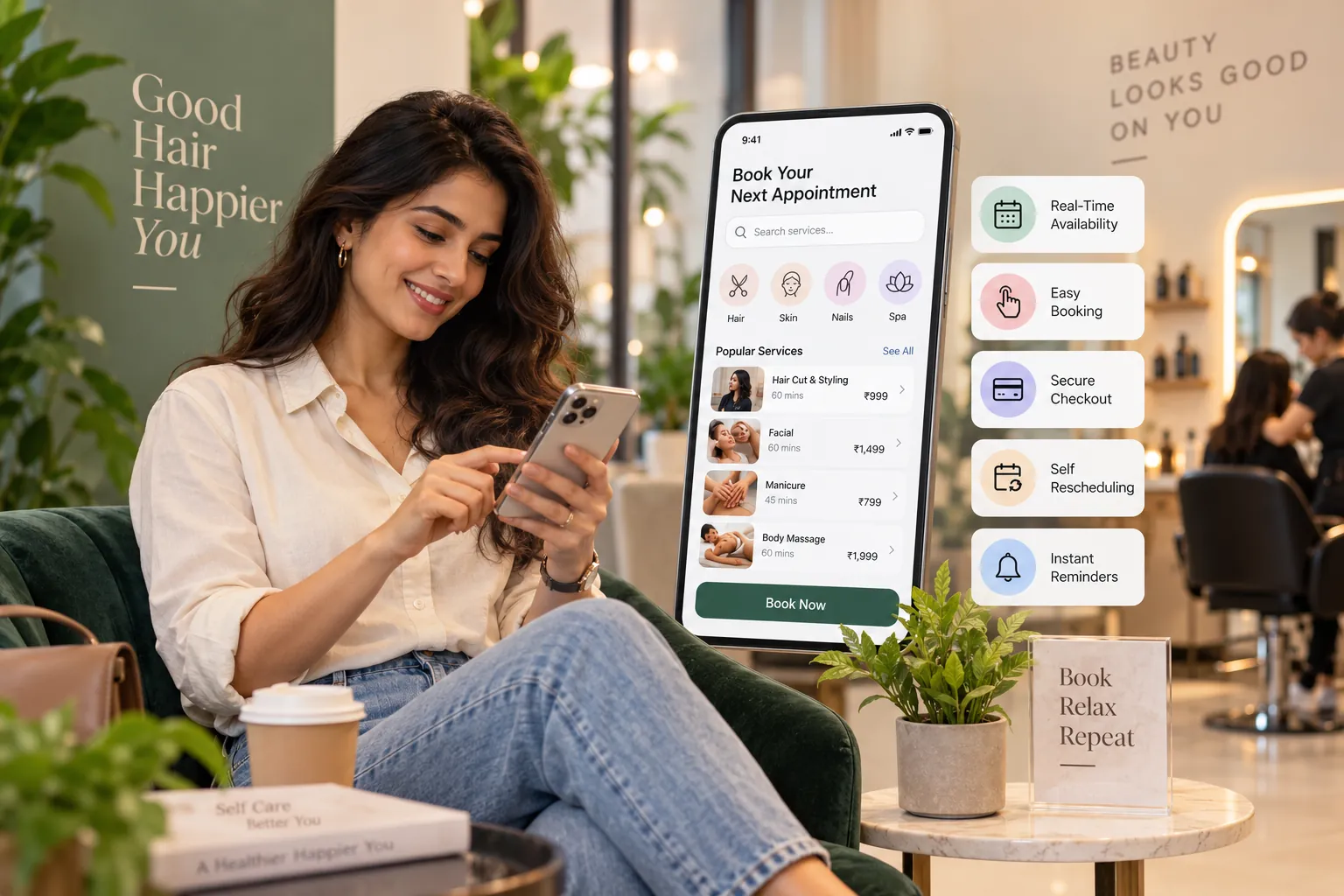
Quick answer: Salon booking apps let customers book and manage appointments from a phone while keeping the salon calendar updated. A good app should offer accurate availability, simple service selection, fast checkout, self-rescheduling and clear reminders without creating a separate customer database or calendar.
Key takeaways
- What is a salon booking app?.
- Native app vs mobile booking website.
- Mobile booking should begin with service clarity.
- Availability must come from the live salon calendar.
- “Any available” can improve conversion.
A salon can have excellent staff and still lose a customer because booking feels difficult on a phone.
That is why the real value of salon booking apps is not the app icon. It is the ability to complete routine booking tasks with less friction.
The best mobile experience makes it easy for customers to find a service, choose a suitable time, confirm the appointment and manage changes—while the salon continues to control staff, rooms, deposits and policy.
What is a salon booking app?
A salon booking app is a mobile interface for appointment booking and appointment management.
It may be used by:
- customers;
- staff;
- reception;
- managers.
These users need different things.
Customers need convenience.
Staff need schedule visibility.
Managers need control.
A strong platform can use the same underlying data while presenting a different mobile experience to each role.
Native app vs mobile booking website
Not every salon needs customers to install an app.
A mobile website can be better for first-time customers because it opens instantly from:
- Google Search;
- Google Business Profile;
- Instagram;
- WhatsApp;
- ads;
- the salon website.
A native app becomes more valuable when the customer has an ongoing relationship with the salon.
Examples include:
- regular rebooking;
- memberships;
- packages;
- loyalty points;
- saved preferences;
- frequent notifications.
The best setup may include both: a friction-light web booking experience for discovery and an app for repeat engagement.
Mobile booking should begin with service clarity
On a small screen, a long service menu becomes difficult to navigate.
Use categories.
Examples:
- Hair
- Beauty
- Nails
- Spa
- Grooming
- Packages
Within each category, show a clear service name, duration and price or starting price where appropriate.
Avoid internal abbreviations.
The booking app should be written for the customer, not for the accounting system.
Availability must come from the live salon calendar
The app should not maintain a second version of availability.
When reception adds a walk-in, the app should update.
When a staff member goes on leave, the app should stop showing their slots.
When a customer reschedules, staff should see the change.
This is basic integration, but it is also one of the most important things to test.
A visually attractive app with delayed calendar synchronisation will create operational problems quickly.
“Any available” can improve conversion
Customers do not always need to choose a particular professional.
Offering “any available” can:
- show earlier times;
- distribute new customers;
- improve capacity use;
- reduce decision friction.
Loyal customers can still choose their preferred professional.
The app should filter staff based on the service, so “any available” means any qualified professional, not simply any person with an empty calendar.
First-time booking: minimise friction
A new customer may not want to create a password, verify an email and complete a profile before seeing a slot.
Ask only for what the salon needs to fulfil the booking.
A practical flow is:
- choose service;
- choose time;
- enter name and contact;
- pay deposit if required;
- confirm.
You can invite the customer to create a fuller profile later.
This is especially useful for paid advertising traffic, where unnecessary steps can waste acquisition spend.
Deposits and mobile payments
If the salon takes deposits, mobile payment should feel like part of the booking rather than a separate checkout.
Show:
- deposit amount;
- what it is for;
- cancellation conditions;
- final booking confirmation.
The salon side should see the payment status immediately.
If reception must search another app to confirm the deposit, the workflow is still fragmented.
Confirmation and reminders
A booking app may use:
- push notification;
- WhatsApp;
- SMS;
- email.
Choose the channel based on customer behaviour and consent.
The message should contain the useful details and a clear action.
A reminder is much stronger when the customer can tap “reschedule” than when the message simply tells them to call reception.
Self-rescheduling
Self-rescheduling is one of the most useful features in a salon booking app.
The system should recheck:
- staff availability;
- service duration;
- room;
- buffer;
- notice period;
- deposit;
- branch.
Customers should be able to manage legitimate changes without creating an impossible slot.
The old appointment should remain in history so the salon can measure reschedule behaviour.
Customer profiles in the app
A repeat customer may benefit from seeing:
- upcoming bookings;
- past bookings;
- preferred staff;
- package balance;
- membership status;
- loyalty points;
- saved details.
Do not expose internal notes or commercial information that is meant only for staff.
Customer-facing profiles and staff CRM views should share data selectively, not mirror each other.
Staff booking apps
Staff mobile access is a different use case.
A stylist or therapist may need:
- today’s appointments;
- customer name;
- service;
- relevant notes;
- arrival status;
- schedule changes;
- leave request;
- limited rebooking tools.
They do not necessarily need:
- customer export;
- full business revenue;
- refunds;
- price configuration;
- every branch.
Role-based mobile access keeps the app useful and reduces risk.
Owner mobile experience
Owners often want to check the business without opening the full desktop dashboard.
Useful mobile signals include:
- today’s sales;
- appointments;
- cancellations;
- no-shows;
- staff attendance;
- unusual gaps;
- branch comparison;
- urgent stock alert.
The owner view should surface exceptions rather than compress every report onto a phone.
Booking apps and loyalty
An app can become more valuable when it gives repeat customers a reason to return.
Loyalty, membership and package information can provide that reason.
Keep the experience simple.
A customer should understand:
- current balance;
- benefit;
- expiry;
- next action.
If the loyalty system requires staff to explain a complicated formula, it may not improve the mobile experience.
Security
Mobile convenience increases the number of places from which business data can be accessed.
Use:
- individual staff logins;
- strong authentication;
- role permissions;
- device logout;
- quick removal of former staff;
- audit history for important changes.
Avoid shared logins.
A shared “reception” password makes it difficult to identify who changed an appointment or issued a refund.
What to test before choosing a salon booking app
New customer
Can they book without creating unnecessary friction?
Repeat customer
Can they rebook quickly?
Staff leave
Does availability change immediately?
Walk-in
Does reception update the app calendar?
Deposit
Is payment tied to the booking?
Reschedule
Does the app apply the salon policy?
Package
Can the customer see or use a valid package correctly?
Staff login
Do staff see only relevant information?
Slow connection
Does the app remain usable on ordinary mobile data?
Export
Does the underlying platform let the business retrieve customer and booking data?
App metrics that matter
Do not focus only on downloads.
A booking app can have many installations and still create little business value.
Track:
- completed mobile bookings;
- repeat bookings;
- self-reschedules;
- cancellation rate;
- no-show rate;
- deposit completion;
- package bookings;
- booking conversion where measurable;
- reduction in routine booking calls.
The app succeeds when customers complete tasks and the salon does less manual coordination.
Implementation checklist for a salon booking app
Before promoting the app or booking link, configure the operating rules behind it.
Start with the service catalogue. Remove duplicate services, confirm durations and decide which services can be booked without staff approval. Then map staff skills and working hours. Add rooms or resources where they affect capacity.
Next, configure customer-facing rules:
- how far in advance a customer can book;
- how close to the appointment they can cancel or reschedule;
- which services require a deposit;
- whether customers can select staff;
- which services are visible online;
- which messages are sent automatically.
Test from a customer phone and a staff phone at the same time. Create a booking, move it from reception, cancel it from the customer side and verify that every screen stays consistent.
Where AI can improve the app experience
AI does not need to be a chatbot sitting on the booking page.
More practical uses include helping the salon recommend relevant services, summarising a customer’s previous visit for staff, identifying customers likely due to rebook or highlighting unusual booking behaviour for the owner.
For customers, AI-assisted search can eventually make a long service catalogue easier to navigate—for example, interpreting “I need a haircut and colour before an event” and guiding the customer to the right booking flow.
Any recommendation should still use the salon’s configured services, prices and real availability. AI should not invent a service or promise a slot the scheduling engine cannot fulfil.
India-specific mobile considerations
In India, customers often move between Instagram, Google, WhatsApp and UPI during the same purchase journey.
A salon booking app should work with that behaviour.
Useful capabilities include a shareable booking link, WhatsApp confirmations, UPI-friendly deposits and a clear way for reception to create a structured appointment from a WhatsApp enquiry.
The goal is not to force every customer into one channel. It is to make sure every confirmed booking ends up in the same operational system.
Search and AI usefulness
This article keeps salon booking apps as the primary subject and answers the main follow-up questions within one page rather than creating thin pages for minor keyword variations. For stronger visibility over time, add original screenshots, workflow diagrams, verified customer examples and first-party benchmarks when available. Those assets give readers information that generic summaries cannot reproduce.
Frequently asked questions
Is a salon booking app better than a booking website?
Not always. A mobile website is easier for new customers because there is nothing to install. An app can be stronger for repeat customers.
Should customers create an account?
Make account creation optional where possible. Capture essential information at booking and let customers save more details later.
Can a salon booking app take payments?
Many apps support deposits or prepayments. Check payment fees, refund flow and integration with the booking record.
Can staff use the same app?
They can use the same platform, but the staff interface and permissions should be different.
Can an app manage packages?
Many salon platforms can show package or membership balances. Test booking eligibility and redemption rules.
What is the most important feature?
Accurate live availability. If the app sells slots the salon cannot fulfil, every other feature becomes secondary.
Final thoughts
The best salon booking apps make routine customer actions easier without weakening salon control.
They do not need to replace every human interaction.
They need to handle the repeatable parts—booking, confirmation, rescheduling and account information—accurately and quickly.
When the app shares one calendar and one customer record with the rest of the salon platform, mobile convenience becomes operational value rather than another disconnected channel.
Related reading
- [Beauty Salon Booking Apps: Features, Customer Experience & How to Choose](/blog/beauty-salon-booking-apps/)
- [Hair Salon Booking Apps: Features, Customer Experience & How to Choose](/blog/hair-salon-booking-apps/)
- [Salon Booking Software: Features, Benefits & How to Choose the Right System](/blog/salon-booking-software/)
- [Beauty Salon Booking Software: Features, Benefits & How to Choose the Right System](/blog/beauty-salon-booking-software/)