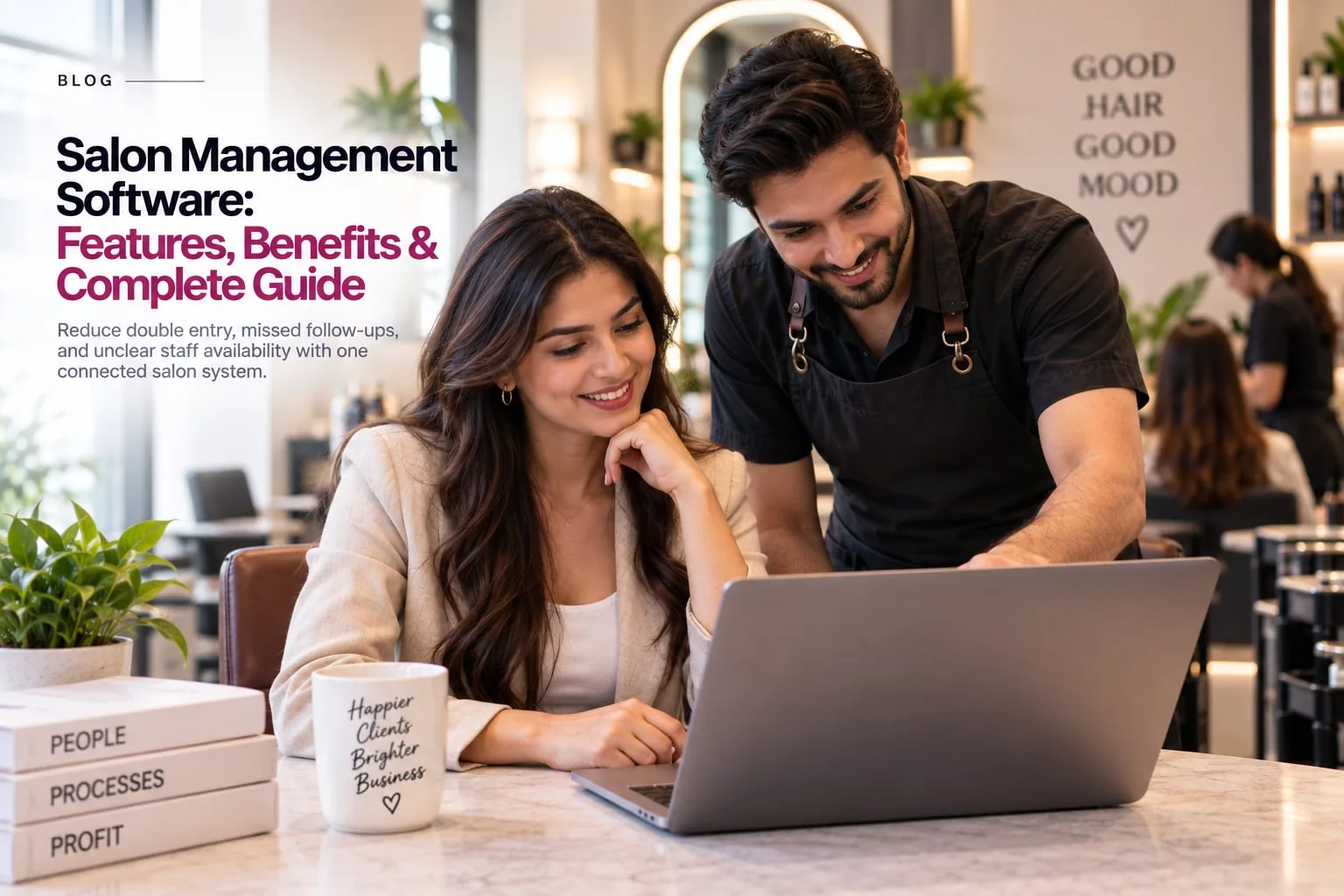
A good digital workflow should feel almost invisible to the client. The booking is clear, the bill is right and the team already knows what it needs to know. This guide is for salons trying to increase repeat business who are researching salon management software. Its search intent is mainly problem-solving informational: the reader wants to understand the category, judge what matters and avoid a purchase that creates a new layer of admin instead of removing one.
One everyday scenario is the 30 to 60 days after a visit, when a timely reminder can matter more than another first-visit discount. The right salon management software workflow keeps information close to the task so the staff member handling the client does not need to rebuild the history first.
Why this category matters now
Salon Management Software is best understood as a business workflow category rather than a single feature. For salons trying to increase repeat business, the goal is to reduce clients quietly lapsing, generic offers, no next-visit logic while keeping the customer experience personal. A capable system should make information easier to capture once, reuse safely and report later. It should not force the team to become software operators at the expense of serving clients.
Category labels are broad; operating needs are specific. Define the required scope of salon management software from your own customer journey and back-office controls before comparing vendor menus.
Core jobs the software must perform
Consider this situation: A staff member goes on unexpected leave and the reception team has to move several appointments without losing customer context. A disconnected setup makes the team translate the same information between people and tools. A connected salon management software workflow should preserve the booking or transaction context, show the next action clearly and leave a trace that can be reviewed later.
This is why clients quietly lapsing and generic offers are not merely administrative irritations. They consume attention at exactly the moment staff should be focused on the client. Reducing those small interruptions can improve consistency without making the salon feel automated or impersonal.
What the front desk experiences
Clients Quietly Lapsing tends to become visible only after scale exposes it. The business then discovers that a small manual habit has turned into recurring rework.
A recurring generic offers problem changes behaviour: employees begin double-recording important details. That feels safe individually but creates a messy information environment for the business.
If a manager must wait for a weekly spreadsheet to notice no next-visit logic, the feedback loop is too slow. Operational exceptions should be visible while they can still influence the next shift or transaction.
A salon can tolerate occasional untracked follow-up, but it should not need a daily manual control to compensate for it. That is a sign the workflow and the operating process are misaligned.
What the owner should see
Visit History
The value of visit history becomes obvious only in everyday use. Visit history gives context to follow-up. A client who had a colour service six weeks ago needs a different message from someone who only purchased a retail product. A salon should be able to configure the rule once, train the team and then use it consistently across busy and quiet periods.
Due Date Logic
A strong implementation of due-date logic should reduce decisions the team has to reconstruct manually. Due-date logic estimates when a customer is likely to need the next service based on the treatment and their own history, giving follow-up better timing. A salon should be able to configure the rule once, train the team and then use it consistently across busy and quiet periods.
Segments
One area to examine closely is segments. Segmentation turns a customer database into a decision tool. Lapsed regulars, high-frequency clients and package users should not all receive the same communication. Ask the vendor to demonstrate a normal case and an exception, because exceptions are where weak workflows usually appear.
Reminders
Do not treat reminders as a checkbox. Reminders reduce forgetfulness, but timing and tone matter. A useful reminder confirms the practical details without feeling like repeated promotional messaging. Ask the vendor to demonstrate a normal case and an exception, because exceptions are where weak workflows usually appear.
Membership Prompts
For salon management software, membership prompts deserves a live test. Membership prompts should appear when they solve a customer need, such as frequent use of a service, rather than being forced into every checkout conversation. If staff need a spreadsheet or WhatsApp note to complete the same process, the feature is not fully connected.
Campaign Tracking
The value of campaign tracking becomes obvious only in everyday use. Campaign tracking should connect messages to bookings or revenue where possible, otherwise the team optimises for delivery and clicks instead of business outcomes. If staff need a spreadsheet or WhatsApp note to complete the same process, the feature is not fully connected.
Feedback
A strong implementation of feedback should reduce decisions the team has to reconstruct manually. Feedback after a visit can surface service recovery opportunities early, but the team needs a clear process for responding rather than collecting ratings for display. The best test is whether a new receptionist can understand what happened without asking the person who entered it.
Where automation helps - and where people still matter
A useful Indian deployment respects both formal controls and everyday flexibility. The system should support clean invoices, permissions and reporting while still allowing managers to handle genuine customer-service exceptions in a controlled way.
A successful salon management software setup becomes the natural place to complete work. Persistent side registers or personal chat notes should be investigated as process signals rather than dismissed as bad habits.
How to compare vendors fairly
The return from salon management software should be measured in operational outcomes, not login counts. A useful scorecard for this topic includes repeat rate, days between visits, reactivation and retention revenue. Choose three or four measures before implementation and record a baseline so the owner can see whether the new process is genuinely improving the business.
Avoid a simplistic 'software equals revenue' argument. salon management software is valuable when it improves the mechanics of the business; commercial improvement follows only when those better mechanics influence capacity, repeat visits, pricing discipline or retail sales.
Numbers to track after launch
- Can you demonstrate visit history using our own service menu rather than sample data?
- What happens when clients quietly lapsing occurs - can staff correct it without losing history?
- What is excluded from the headline price, especially training, imports, messaging, additional branches and third-party connections?
- Please explain the migration-out process, including export formats, timing and any charges for retrieving business data.
- Which permissions can be limited by role, branch or responsibility?
- Can branch managers access training and helpdesk support when staff turnover creates new users later?
A good sales demo should survive these questions comfortably. The aim is not to catch the vendor out; it is to discover whether the system can handle the ordinary exceptions that make salon operations real. For salon management software, one live end-to-end workflow is more informative than twenty screenshots.
A short implementation playbook
- Plan an explicit switch-off date for duplicate tracking. A mature salon management software setup is easier to govern when everyone knows which system is authoritative.
- Start with the menu clients and staff actually use today. Standardise the service list in salon management software and avoid carrying forward duplicate or outdated items just because they exist in an old file.
- User setup should follow the organisation chart. Give each person enough salon management software access to do the job well, but keep price edits, bulk exports and system configuration with the roles that own those decisions.
- Migration should improve data quality, not preserve clutter. Review the client list before salon management software launch and keep only records that have operational or historical value.
- Sequence salon management software training by frequency and risk: teach common front-desk actions first, then exceptions, then management features. That approach reduces mistakes during the first live week.
- During the transition, close each day with a quick salon management software review. Small mismatches are much easier to solve when the staff member and transaction details are still available.
Implementation succeeds when the team understands why the process changed. Explain the customer or business problem behind each rule. People are more likely to use salon management software correctly when they can see that it prevents a specific headache rather than simply satisfying management's desire for a new system.
Bottom line
Wellnito is designed for salon and spa operations, but the final decision should still come from a workflow test. For salon management software, focus on the parts that matter most to this article: visit history, due-date logic, segments, reminders. If those are simple for staff and visible to managers, the product is solving the right problem.
Frequently Asked Questions
Is this type of salon software suitable for a small business?
Yes, if the workflow is simple enough to configure without adding unnecessary admin. A small salon should prioritise the two or three problems it actually has and avoid paying for complexity it will not use. Salon Management Software becomes more valuable as bookings, staff and customer history grow.
Can the system work with walk-ins as well as appointments?
A salon should not have to choose between appointments and walk-ins. salon management software should support both models and keep the resulting customer and revenue data in one place.
What should I ask during a software demo?
Ask to see salon management software behave under a scenario your salon actually faces. A normal case plus one difficult edge case will reveal more about fit than a long presentation of isolated modules.
How quickly can a salon team learn the system?
Training works best in layers. Establish day-to-day competence in salon management software, then add reports, campaigns and advanced controls as the team becomes ready to use them.
Does salon software remove the need for staff judgement?
Automation has limits in a service business. salon management software can organise the standard case, but managers and professionals still need room to make responsible decisions when the standard case does not fit.
Conclusion
How Salon Management Software Helps Increase Repeat Customers is ultimately a business-process question. The strongest salon management software is the one that matches how your salon actually works, removes repeated manual steps and gives staff enough context to serve customers confidently. Use the keyword research to find the category, but use real workflows to make the buying decision. Measure the result through repeat rate, days between visits, reactivation and retention revenue, and keep the setup simple enough that the team can follow it on the busiest day of the week.