Quick answer
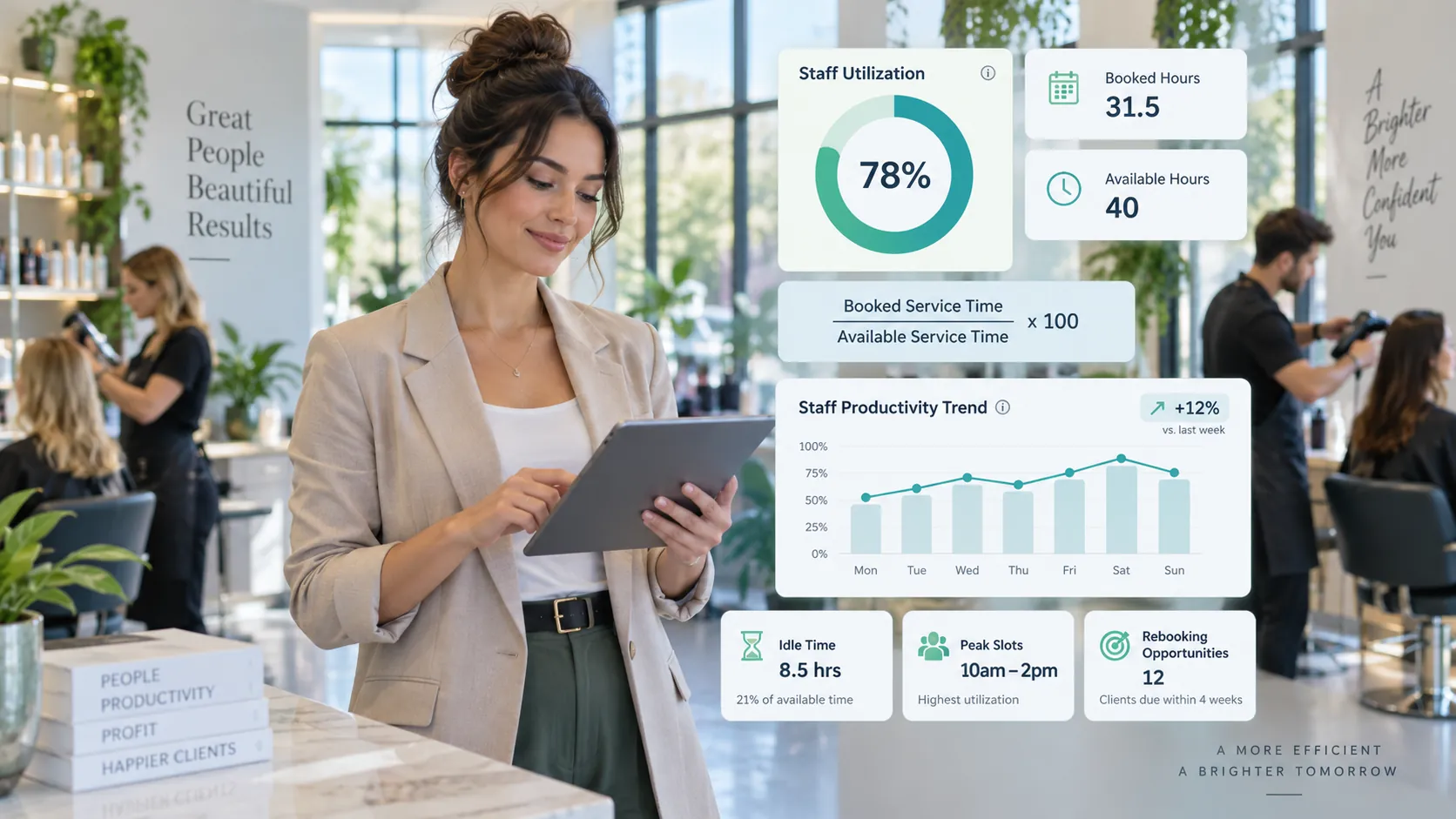
Salon staff utilisation measures how much of a staff member's available working time is used for productive appointment time. A common formula is booked service time divided by available service time, multiplied by 100.
This guide focuses specifically on calculating productive booked time against realistic available service time and using the result to improve demand and roster decisions. That narrower scope helps the article answer one search intent thoroughly instead of repeating a general salon-software explanation.
Key takeaways
- Define available time carefully by excluding approved leave, training and breaks where appropriate.
- Use service duration rather than appointment count because a three-hour colour service and a 20-minute trim do not consume equal capacity.
- Review utilisation by day and time to distinguish weak demand from poor shift planning.
- Compare utilisation with revenue per hour because being fully booked with low-value services may still produce weak economics.
- Do not target 100% utilisation continuously; salons need buffers for cleanup, consultation, walk-ins and schedule disruption.
Start with the business question
A measurement page about salon staff utilization should begin with the decision the owner needs to make. The number is useful only when its definition stays consistent across periods and the manager knows which operational action follows a change.
The focus here is calculating productive booked time against realistic available service time and using the result to improve demand and roster decisions. That means data quality, denominator choice and cohort or capacity definitions matter more than producing a large dashboard.
Measurement framework
- Define the numerator and denominator for salon staff utilization before reviewing performance.
- Keep the salon staff utilization definition stable across branches and time periods.
- Compare a salon staff utilization trend or cohort instead of one isolated day.
- Segment salon staff utilization only when the split can change a decision.
- Pair the salon staff utilization KPI with a customer or capacity measure so optimisation does not become one-dimensional.
Practices that make the metric actionable
1. Define available time carefully by excluding approved leave, training and breaks where appropriate
Build this point into the salon staff utilization workflow as a exception handling. The rule should remain understandable when a new employee follows it without the owner standing nearby.
Measure Utilisation % and review any override reasons. For salon staff utilization, frequent overrides usually signal that the business rule, source data or permission design needs attention.
2. Use service duration rather than appointment count because a three-hour colour service and a 20-minute trim do not consume equal capacity
Use this point to strengthen the salon's scale test for salon staff utilization. Decide what success looks like before activating automation, and preserve enough history for a manager to audit the outcome.
Compare Revenue Per Available Hour before and after the pilot. A salon staff utilization workflow is ready to scale when the result is repeatable without extra spreadsheets, side notes or constant manager intervention.
3. Review utilisation by day and time to distinguish weak demand from poor shift planning
In salon staff utilization, this point belongs to the salon's practical control. Name the owner, identify the source record and define the fallback before the rule goes live.
After real usage, compare Booked Hours with the baseline. For salon staff utilization, investigate the actual client, staff or transaction records behind unusual movement before changing the target.
4. Compare utilisation with revenue per hour because being fully booked with low-value services may still produce weak economics
Treat this salon staff utilization step as a customer impact. The team should know which data starts the action, which role can change it and how an exception is documented.
Review Available Hours after enough cases to see a pattern. If salon staff utilization improves the number only by adding hidden manual work, simplify the workflow before scaling it.
5. Do not target 100% utilisation continuously; salons need buffers for cleanup, consultation, walk-ins and schedule disruption
For salon staff utilization, make this management decision explicit in the operating process. Avoid relying on memory or private messages when the action affects a client, appointment, payment or stock record.
Use No-Show Lost Hours as evidence, not as a vanity number. A salon staff utilization change is stronger when the metric improves and the staff process becomes easier to follow at the same time.
6. Use skill-based scheduling to shift demand toward qualified team members with spare capacity
This is a data requirement within salon staff utilization. Configure the normal path first, then decide who handles the uncommon case and where the correction appears later.
Once the rule is live, inspect Rebooking By Staff together with exception volume. For salon staff utilization, a stable process should reduce repeated corrections rather than merely hide them.
7. Track cancellations and no-shows separately because they reduce realised utilisation after the calendar initially looked full
A good salon staff utilization setup treats this point as a operating rule. Keep the required fields and approvals limited to what the salon genuinely needs during a busy shift.
Check Utilisation % on a regular cadence. If salon staff utilization produces different results by branch, staff member or service, trace the difference to demand, configuration or execution before standardising a fix.
8. Coach low-utilisation staff using client retention, rebooking and demand-building actions rather than simply reducing shifts
Within salon staff utilization, this commercial check should be testable from one real salon case. Staff must be able to show the record that triggered the action and the record that confirms completion.
Track Revenue Per Available Hour after the change and compare it with a relevant customer or capacity measure. That prevents salon staff utilization from optimising one department while creating a problem elsewhere.
Metrics to track
KPI | Management use |
Utilisation % | Primary outcome for salon staff utilization. |
Revenue Per Available Hour | Shows whether salon staff utilization is consistent. |
Booked Hours | Highlights leakage connected with salon staff utilization. |
Available Hours | Adds commercial context to salon staff utilization. |
No-Show Lost Hours | Helps diagnose salon staff utilization by segment. |
Rebooking By Staff | Supports the scale decision for salon staff utilization. |
For salon staff utilization, pick one primary KPI and use the others diagnostically. A dashboard is useful only when a number leads to a clear management question or action.
Worked interpretation example
Suppose Utilisation % improves but Rebooking By Staff weakens. Do not celebrate or reverse the change immediately. Inspect which staff, service, client cohort or branch created the movement and connect it back to the operating rules in this guide.
For salon staff utilization, context is especially important because a stronger average can hide weak performance in a high-value segment. The management goal is explanation, not merely reporting.
Frequently asked questions
What is salon staff utilization?
Salon staff utilisation measures how much of a staff member's available working time is used for productive appointment time. A common formula is booked service time divided by available service time, multiplied by 100.
Where should a salon start with salon staff utilization?
Start by documenting the current process and measuring utilisation %. Then apply this first principle: Define available time carefully by excluding approved leave, training and breaks where appropriate. Keep the pilot small enough to inspect exceptions.
How do you measure salon staff utilization?
Useful measures include utilisation %, revenue per available hour, booked hours, available hours. Choose one primary outcome and use the others to understand why it changed.
Can a small salon use salon staff utilization?
Yes. A small salon should use the simplest version of salon staff utilization that removes a recurring manual problem or improves a measurable customer outcome. Complexity should be added only when the team needs it.
What should software support for salon staff utilization?
For salon staff utilization, the system should connect the relevant client, appointment, staff, payment or inventory event to the manager's report. Test a normal salon staff utilization case, a correction and an exception before choosing a platform.
Practical management review for salon staff utilization
A monthly review of salon staff utilization should stay centred on one operating question: is the salon getting better at calculating productive booked time against realistic available service time and using the result to improve demand and roster decisions? Start the meeting with Utilisation %, then open the appointments, client records, transactions or stock movements that explain unusual changes. This prevents the discussion from becoming a review of dashboard colours instead of business behaviour.
Next, check whether the team can consistently define available time carefully by excluding approved leave, training and breaks where appropriate. If staff are using private notes, manual lists or personal messages to finish the process, record that as an implementation gap rather than accepting it as normal. Then test whether the salon can review utilisation by day and time to distinguish weak demand from poor shift planning under a busy-period scenario.
Finish by comparing Utilisation % with Rebooking By Staff. A stronger primary result is not a complete success if it creates new customer friction, additional staff administration or weaker commercial quality elsewhere. Assign one change for the next review period and keep the definition of the KPIs unchanged so the next comparison remains meaningful.
Search and AI visibility notes
This article is intentionally centred on salon staff utilization and its related follow-up questions. It should link to broader Wellnito guides when another subject needs deeper explanation rather than duplicating the same material here.
To make this salon staff utilization guide stronger over time, add first-party evidence such as verified Wellnito screenshots, anonymised workflow examples, calculators, benchmarks or short videos. Original evidence is more useful to readers and more defensible in AI-assisted search than generic summary content.
Final takeaway
Salon Staff Utilization should improve a real salon outcome and make the underlying process easier to execute or manage. Start with a baseline, test the rule under real operating conditions and scale only when both the numbers and the staff experience support the change.
Wellnito can calculate utilisation from roster and appointment data and connect it with revenue and client outcomes.
Related reading
- [Salon Scheduling Software: Appointments, Staff Scheduling & Calendar Management Guide](/blog/salon-scheduling-software/)
- [Beauty Salon Scheduling Software: Appointments, Staff Scheduling & Calendar Management Guide](/blog/beauty-salon-scheduling-software/)
- [Hair Salon Scheduling Software: Appointments, Staff Scheduling & Calendar Management Guide](/blog/hair-salon-scheduling-software/)
- [Salon Staff Commission & Payroll Management: Complete Guide](/blog/salon-staff-commission-payroll-management-complete-guide/)